Chapter 17 Planning Based on Model Checking
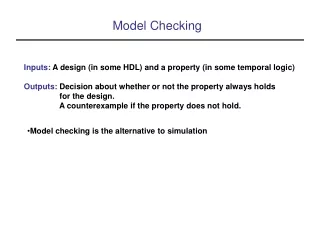
This chapter explores the fundamentals of planning based on model checking in nondeterministic systems. It examines actions with multiple outcomes, failures, and exogenous events, providing insights into policies that govern state transitions. Key concepts include the representation of states and actions, execution paths of policies, and types of solutions (weak, strong, and strong-cyclic). By leveraging nondeterministic frameworks, planners can build effective strategies even under uncertain conditions, enhancing the development of robust automated systems.

Chapter 17 Planning Based on Model Checking
E N D
Presentation Transcript
Lecture slides for Automated Planning: Theory and Practice Chapter 17Planning Based on Model Checking Dana S. Nau University of Maryland 10:16 AMSeptember 3, 2014
Motivation c b a • Actions with multiple possibleoutcomes • Action failures • e.g., gripper drops its load • Exogenous events • e.g., road closed • Nondeterministic systems are like Markov Decision Processes (MDPs), but without probabilities attached to the outcomes • Useful if accurate probabilities aren’t available, or if probability calculations would introduce inaccuracies Intendedoutcome c grasp(c) a b c a b Unintendedoutcome
Nondeterministic Systems • Nondeterministic system: a triple = (S, A, ) • S = finite set of states • A = finite set of actions • : S A 2s • Like in the previous chapter, the book doesn’t commit to any particular representation • It only deals with the underlying semantics • Draw the state-transition graph explicitly • Like in the previous chapter, a policy is a function from states into actions • π: SA • Notation: Sπ = {s | (s,a) π} • In some algorithms, we’ll temporarily have nondeterministic policies • Ambiguous: multiple actions for some states • π: S 2A, or equivalently, π S A • We’ll always make these policies deterministic before the algorithm terminates
Example 2 • Robot r1 startsat location l1 • Objective is toget r1 to location l4 • π1 = {(s1, move(r1,l1,l2)), (s2, move(r1,l2,l3)), (s3, move(r1,l3,l4))} • π2 = {(s1, move(r1,l1,l2)), (s2, move(r1,l2,l3)), (s3, move(r1,l3,l4)), (s5, move(r1,l3,l4))} • π3 = {(s1, move(r1,l1,l4))} Start Goal
Example 2 • Robot r1 startsat location l1 • Objective is toget r1 to location l4 • π1 = {(s1, move(r1,l1,l2)), (s2, move(r1,l2,l3)), (s3, move(r1,l3,l4))} • π2 = {(s1, move(r1,l1,l2)), (s2, move(r1,l2,l3)), (s3, move(r1,l3,l4)), (s5, move(r1,l3,l4))} • π3 = {(s1, move(r1,l1,l4))} Start Goal
Example 2 • Robot r1 startsat location l1 • Objective is toget r1 to location l4 • π1 = {(s1, move(r1,l1,l2)), (s2, move(r1,l2,l3)), (s3, move(r1,l3,l4))} • π2 = {(s1, move(r1,l1,l2)), (s2, move(r1,l2,l3)), (s3, move(r1,l3,l4)), (s5, move(r1,l3,l4))} • π3 = {(s1, move(r1,l1,l4))} Start Goal
Execution Structures 2 s5 • Execution structurefor a policy π: • The graph of all ofπ’s execution paths • Notation: π = (Q,T) • QS • T S S • π1 = {(s1, move(r1,l1,l2)), (s2, move(r1,l2,l3)), (s3, move(r1,l3,l4))} • π2 = {(s1, move(r1,l1,l2)), (s2, move(r1,l2,l3)), (s3, move(r1,l3,l4)), (s5, move(r1,l3,l4))} • π3 = {(s1, move(r1,l1,l4))} s2 s3 Start Goal s1 s4
Execution Structures s5 • Execution structurefor a policy π: • The graph of all ofπ’s execution paths • Notation: π = (Q,T) • QS • T S S • π1 = {(s1, move(r1,l1,l2)), (s2, move(r1,l2,l3)), (s3, move(r1,l3,l4))} • π2 = {(s1, move(r1,l1,l2)), (s2, move(r1,l2,l3)), (s3, move(r1,l3,l4)), (s5, move(r1,l3,l4))} • π3 = {(s1, move(r1,l1,l4))} s2 s3 s1 s4
Execution Structures 2 s5 • Execution structurefor a policy π: • The graph of all ofπ’s execution paths • Notation: π = (Q,T) • QS • T S S • π1 = {(s1, move(r1,l1,l2)), (s2, move(r1,l2,l3)), (s3, move(r1,l3,l4))} • π2 = {(s1, move(r1,l1,l2)), (s2, move(r1,l2,l3)), (s3, move(r1,l3,l4)), (s5, move(r1,l3,l4))} • π3 = {(s1, move(r1,l1,l4))} s2 s3 Start Goal s1 s4
Execution Structures s5 • Execution structurefor a policy π: • The graph of all ofπ’s execution paths • Notation: π = (Q,T) • QS • T S S • π1 = {(s1, move(r1,l1,l2)), (s2, move(r1,l2,l3)), (s3, move(r1,l3,l4))} • π2 = {(s1, move(r1,l1,l2)), (s2, move(r1,l2,l3)), (s3, move(r1,l3,l4)), (s5, move(r1,l3,l4))} • π3 = {(s1, move(r1,l1,l4))} s2 s3 s1 s4
Execution Structures 2 • Execution structurefor a policy π: • The graph of all ofπ’s execution paths • Notation: π = (Q,T) • QS • T S S • π1 = {(s1, move(r1,l1,l2)), (s2, move(r1,l2,l3)), (s3, move(r1,l3,l4))} • π2 = {(s1, move(r1,l1,l2)), (s2, move(r1,l2,l3)), (s3, move(r1,l3,l4)), (s5, move(r1,l3,l4))} • π3 = {(s1, move(r1,l1,l4))} Start Goal s1 s4
Execution Structures • Execution structurefor a policy π: • The graph of all ofπ’s execution paths • Notation: π = (Q,T) • QS • T S S • π1 = {(s1, move(r1,l1,l2)), (s2, move(r1,l2,l3)), (s3, move(r1,l3,l4))} • π2 = {(s1, move(r1,l1,l2)), (s2, move(r1,l2,l3)), (s3, move(r1,l3,l4)), (s5, move(r1,l3,l4))} • π3 = {(s1, move(r1,l1,l4))} s1 s4
s0 s3 a2 a0 s2 s1 Goal a1 Types of Solutions • Weak solution: at least one execution path reaches a goal • Strong solution: every execution path reaches a goal • Strong-cyclic solution: every fair execution path reaches a goal • Don’t stay in a cycle forever if there’s a state-transition out of it s0 s3 Goal a2 a0 s2 s1 Goal a3 a1 a3 s0 s3 a2 a0 Goal s2 s1 a1
Finding Strong Solutions • Backward breadth-first search • StrongPreImg(S) = {(s,a) : (s,a) ≠ ,(s,a) S} • all state-action pairs for whichall of the successors are in S • PruneStates(π,S) = {(s,a) π : s S} • S is the set of states we’vealready solved • keep only the state-actionpairs for other states • MkDet(π') • π' is a policy that may be nondeterministic • remove some state-action pairs ifnecessary, to get a deterministic policy
Example 2 π = failure π' = Sπ' = SgSπ'= {s4} Start s4 Goal
Example s5 2 π = failure π' = Sπ' = SgSπ'= {s4} π'' PreImage = {(s3,move(r1,l3,l4)), (s5,move(r1,l5,l4))} s3 Start s4 Goal
Example s5 2 π = failure π' = Sπ' = SgSπ'= {s4} π'' PreImage = {(s3,move(r1,l3,l4)), (s5,move(r1,l5,l4))} π π'= π' π'Uπ'' = {(s3,move(r1,l3,l4)), (s5,move(r1,l5,l4))} s3 Start s4 Goal
Example s5 2 π = π' = {(s3,move(r1,l3,l4)), (s5,move(r1,l5,l4))} Sπ' = {s3,s5} SgSπ'= {s3,s4,s5} s3 Start s4 Goal
Example s5 2 s2 π = π' = {(s3,move(r1,l3,l4)), (s5,move(r1,l5,l4))} Sπ' = {s3,s5} SgSπ'= {s3,s4,s5} PreImage {(s2,move(r1,l2,l3)), (s3,move(r1,l3,l4)), (s5,move(r1,l5,l4)),(s3,move(r1,l4,l3)), (s5,move(r1,l4,l5))} π'' {(s2,move(r1,l2,l3))} π π' = {(s3,move(r1,l3,l4)), (s5,move(r1,l5,l4))} π' {(s2,move(r1,l2,l3), (s3,move(r1,l3,l4)), (s5,move(r1,l5,l4))} s3 Start s4 Goal
Example s5 2 s2 π= {(s3,move(r1,l3,l4)), (s5,move(r1,l5,l4))} π' = {(s2,move(r1,l2,l3)),(s3,move(r1,l3,l4)), (s5,move(r1,l5,l4))} Sπ' = {s2,s3,s5} SgSπ'= {s2,s3,s4,s5} s3 Start s4 Goal
Example s5 2 s2 π= {(s3,move(r1,l3,l4)), (s5,move(r1,l5,l4))} π' = {(s2,move(r1,l2,l3)),(s3,move(r1,l3,l4)), (s5,move(r1,l5,l4))} Sπ' = {s2,s3,s5} SgSπ'= {s2,s3,s4,s5} π'' {(s1,move(r1,l1,l2))} π π' = {(s2,move(r1,l2,l3)),(s3,move(r1,l3,l4)), (s5,move(r1,l5,l4))} π' {(s1,move(r1,l1,l2)), (s2,move(r1,l2,l3)), (s3,move(r1,l3,l4)), (s5,move(r1,l5,l4))} s3 Start s1 s4 Goal
Example s5 2 s2 π= {(s2,move(r1,l2,l3)),(s3,move(r1,l3,l4)), (s5,move(r1,l5,l4))} π' = {(s1,move(r1,l1,l2)), (s2,move(r1,l2,l3)),(s3,move(r1,l3,l4)), (s5,move(r1,l5,l4))} Sπ'= {s1,s2,s3,s5} Sg Sπ'= {s1,s2,s3,s4,s5} s3 Start s1 s4 Goal
Example s5 2 s2 π= {(s2,move(r1,l2,l3)),(s3,move(r1,l3,l4)), (s5,move(r1,l5,l4))} π' = {(s1,move(r1,l1,l2)), (s2,move(r1,l2,l3)),(s3,move(r1,l3,l4)), (s5,move(r1,l5,l4))} Sπ'= {s1,s2,s3,s5} SgSπ'= {s1,s2,s3,s4,s5} S0 SgSπ' MkDet(π') = π' s3 Start s1 s4 Goal
Finding Weak Solutions • Weak-Plan is just like Strong-Plan except for this: • WeakPreImg(S) = {(s,a) : (s,a) i S ≠ } • at least one successor is in S Weak Weak
Example 2 π = failure π' = Sπ' = SgSπ'= {s4} Start s4 Goal Weak Weak
Example s5 2 π = failure π' = Sπ' = SgSπ'= {s4} π'' = PreImage = {(s1,move(r1,l1,l4)),(s3,move(r1,l3,l4)), (s5,move(r1,l5,l4))} π π'= π' π'Uπ'' = {(s1,move(r1,l1,l4)),(s3,move(r1,l3,l4)), (s5,move(r1,l5,l4))} s3 Start s1 s4 Goal Weak Weak
Example s5 2 π = π' = {(s1,move(r1,l1,l4)),(s3,move(r1,l3,l4)), (s5,move(r1,l5,l4))} Sπ' = {s1,s3,s5} SgSπ'= {s1,s3,s4,s5} S0 SgSπ' MkDet(π') = π' s3 Start s1 s4 Goal Weak Weak
Finding Strong-Cyclic Solutions • Begin with a “universal policy” π' that contains all state-action pairs • Repeatedly, eliminate state-action pairs that take us to bad states • PruneOutgoing removes state-action pairs that go to states not in Sg∪Sπ • PruneOutgoing(π,S) = π – {(s,a) π : (s,a) S∪Sπ • PruneUnconnected removes states from which it is impossible to get to Sg • Start with π' = , compute fixpoint of π' π ∩ WeakPreImg(Sg∪Sπ’)
FindingStrong-Cyclic Solutions s5 2 s2 Once the policy stops changing, • If it’s not a solution, returnfailure • RemoveNonProgressremoves state-actionpairs that don’t gotoward the goal • implement asbackward searchfrom the goal • MkDet makes surethere’s only one actionfor each state s3 Start s1 s4 s6 Goal at(r1,l6)
Example 1 s5 2 s2 π π' {(s,a) : a is applicable to s} s3 Start s1 s4 s6 Goal at(r1,l6)
Example 1 s5 2 s2 π π' {(s,a) : a is applicable to s} π {(s,a) : a is applicable to s} PruneOutgoing(π',Sg) = π' PruneUnconnected(π',Sg) = π' RemoveNonProgress(π') = ? s3 Start s1 s4 s6 Goal at(r1,l6)
Example 1 s5 2 s2 π π' {(s,a) : a is applicable to s} π {(s,a) : a is applicable to s} PruneOutgoing(π',Sg) = π' PruneUnconnected(π',Sg) = π' RemoveNonProgress(π') = as shown s3 Start s1 s4 s6 Goal at(r1,l6)
Example 1 s5 2 s2 π π' {(s,a) : a is applicable to s} π {(s,a) : a is applicable to s} PruneOutgoing(π',Sg) = π' PruneUnconnected(π',Sg) = π' RemoveNonProgress(π') = as shown MkDet(…) = either{(s1,move(r1,l1,l4), (s2,move(r1,l2,l3)), (s3,move(r1,l3,l4), (s4,move(r1,l4,l6), (s5,move(r1,l5,l4)} or {(s1,move(r1,l1,l2), (s2,move(r1,l2,l3)), (s3,move(r1,l3,l4), (s4,move(r1,l4,l6), (s5,move(r1,l5,l4)} s3 Start s1 s4 s6 Goal at(r1,l6)
Example 2: no applicable actions at s5 s5 2 s2 π π' {(s,a) : a is applicable to s} s3 Start s1 s4 s6 Goal at(r1,l6)
Example 2: no applicable actions at s5 s5 2 s2 π π' {(s,a) : a is applicable to s} π {(s,a) : a is applicable to s} PruneOutgoing(π',Sg) = … s3 Start s1 s4 s6 Goal at(r1,l6)
Example 2: no applicable actions at s5 s5 2 s2 π π' {(s,a) : a is applicable to s} π {(s,a) : a is applicable to s} PruneOutgoing(π',Sg) = π' s3 Start s1 s4 s6 Goal at(r1,l6)
Example 2: no applicable actions at s5 2 s2 π π' {(s,a) : a is applicable to s} π {(s,a) : a is applicable to s} PruneOutgoing(π',Sg) = π' PruneUnconnected(π',Sg) = as shown s3 Start s1 s4 s6 Goal at(r1,l6)
Example 2: no applicable actions at s5 2 s2 π π' {(s,a) : a is applicable to s} π {(s,a) : a is applicable to s} PruneOutgoing(π',Sg) = π' PruneUnconnected(π',Sg)= as shown π' as shown s3 Start s1 s4 s6 Goal at(r1,l6)
Example 2: no applicable actions at s5 2 s2 π'as hown π π' PruneOutgoing(π',Sg) = π' PruneUnconnected(π',Sg) = π' so π = π' RemoveNonProgress(π') =… s3 Start s1 s4 s6 Goal at(r1,l6)
Example 2: no applicable actions at s5 2 s2 π'shown π π' PruneOutgoing(π',Sg) = π' PruneUnconnected(π'',Sg) = π' so π = π' RemoveNonProgress(π') =as shown MkDet(shown) =no change s3 Start s1 s4 s6 Goal at(r1,l6)
Planning for Extended Goals wait • Here, “extended” means temporally extended • Constraints that apply to some sequence of states • Examples: • want to move to l3,and then to l5 • want to keep goingback and forthbetween l3 and l5 2 wait move(r1,l2,l1) wait Goal wait Start
Planning for Extended Goals • Context: the internal state of the controller • Plan: (C, c0, act, ctxt) • C = a set of execution contexts • c0 is the initial context • act: S C A • ctxt: S C S C • Sections 17.3 extends the ideas in Sections 17.1 and 17.2 to deal with extended goals • We’ll skip the details