Mastering Effective Presentation Skills: Techniques for Success
This presentation guide outlines essential steps to enhance your presentation skills. Key elements include defining your objective, researching your topic, understanding your audience, and structuring your content with a clear introduction, body, and conclusion. It emphasizes the importance of visual aids, effective language techniques, and engaging your audience through questions. Additionally, this resource offers expressions for effective communication and highlights significant oral skills like clarity, eye contact, and pronunciation. Prepare to make impactful presentations with these strategies!


Mastering Effective Presentation Skills: Techniques for Success
E N D
Presentation Transcript
PRESENTATION Resista Vikaliana
Steps Use in Planning Presentation • Set the objective of the presentation • Research the topic • Analyze the needs of the audience • Formulate a clear introduction • Select information which the audience needs on the topic and which makes the advantages clear • Review the advantages and finish with a clear closing statement • Provide time for audience questions • Inculude language techniques to help direct the attention of the audience • Prepare visual aids • Practise the entire presentation Resista Vikaliana
Expressions • I would like to say first of all thank you for coming • And the idea is to.... • One of the areas which... • Good morning. I’m... • Perhaps we could begin by outlining.... • I attach a proposed agenda for this year’s conference Resista Vikaliana
Expressions • I agree with..... • I can stand with.... • In my opinion..... • Actually,............ but....... • According to my opinion,......... • Based on the data/ the fact, the......, but I think...... Resista Vikaliana
Attention A good speaker uses language to help direct the attention of the listeners. Look at the some of the techniques: • Enumerate: The first point is... • Emphasize: A principal advantage is... • Repeat: ... A 15 percent rise in costs. 15 percent! • Restate: Let’s look at that another way.... • Focus: Look at these figures • Link: We’ve seen the advantages; let’s now examine the costs • Explain: Finally, profit lock, by which I mean.... • Sum up: So here are a number of situations described so far where... Resista Vikaliana
Exercise • Prepare a short presentation about one of tax topic before in a group (max 4 persons each group) Resista Vikaliana
Here the tips from Prof. Milind Malshe ....... Resista Vikaliana
COMMUNICATION & PRESENTATION SKILLS ORAL SKILLS & SPOKEN ENGLISH MILIND MALSHE Professor Department of Humanities & Social Sciences IIT-BOMBAY
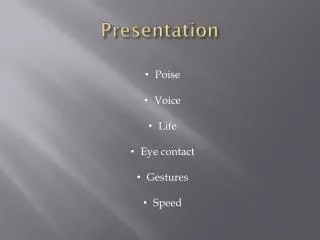
MAIN POINTS TO REMEMBER ABOUT ORAL PRESENTATION • (i) effective use of visual aids • (ii) adequate eye contact : size of the audience • (iii) clarity in pronunciation and fluency • (iv) maintaining a proper speed of presentation • (v) posture and body movements suggesting confidence • (vi) seeking and making proper use of visual feedback • (vii) noting down important points arising out of discussion
DEVELOPING ORAL SKILLS • 1. Speech & Writing/Printing: a comparison • Speech : pitch, volume, tone, speed, pauses, body movements, facial expressions • Writing/Printing: punctuation, capitalization, spacing, margins, fonts
DEVELOPING ORAL SKILLS (continued) • 2. Pronunciation of Words: (a) vowel and consonant sounds • (comparison of sounds with letters a-z); The letter “a” in : fat /æ/, father /a:/, fate /eɪ/, about /ə/ Or the letters “th” in “thin” /ɵ/ & “then” /ð/. Also notice (b) word-stress: ‘language, communi’cation
DEVELOPING ORAL SKILLS (continued) • 3. Use of the phonetic script and the (Pronouncing) Dictionary: International Phonetic Alphabet: free downloading is possible • Dictionaries on CD : listening to the pronunciation and it variety (e.g. British & American) now possible
Attributes of good oral communication • 1.Sounds and sound combinations • 2. Stress • 3. Rhythm • 4. Intonation • 5. Speed: pausing • 6. Clarity of articulation • 7. Voice modulation: volume & pitch variation (avoiding “monotonous speech)
The meaning of public speaking Dr. Tran, Van Hoai Resista Vikaliana
Public speaking (1) • Purposes • To entertain • To inform • To inspire • To convince • To persuade
Public speaking (2) • 3 parts • Introduction: to attract the listener • Body: organized logically in order to be rememberd by listener • Speeches should not contain more than 4 major points • Conclusion: to review main points and challenges