The Role of Highly Skilled Returnees in Social Capital Development in Mozambique
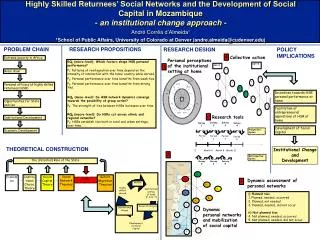
This research explores how highly skilled returnees (HSRs) contribute to the development of social capital in Mozambique through their social networks and institutional engagement. By employing an institutional change approach, the study analyzes the dynamics of personal networks, the impact of weak and strong ties, and the potential for collective action among returnees. Findings highlight the factors that influence HSR performance and suggest possible state policies to optimize the reintegration of skilled professionals for economic and social advancement.

The Role of Highly Skilled Returnees in Social Capital Development in Mozambique
E N D
Presentation Transcript
Highly Skilled Returnees’ Social Networks and the Development of Social Capital in Mozambique - an institutional change approach - AndréCorrêa d’Almeida1 1School of Public Affairs, University of Colorado at Denver (andre.almeida@cudenver.edu) I Return Highly skilled abroad Institutional setting at home (P, K, R, T) Social Strategies Institutional change Development of Social Capital Agent B Agent A T R K A R1 R1 R1 G1 G1 G1 Survey 2 Survey 3 Survey 1 Survey 4 P2 P2 P2 Prospective Cycles P8 T1 T1 T1 P5 Period 1 Period 2 Period 3 Period 4 K1 K1 K1 K3 P1 P1 P1 … 0 Month 4 Month 8 Month 12 T1 P3 P3 P3 The (Potential) Role of the State Retrospective Cycles P7 Survey 2 Survey 3 Survey 4 G2 R2 Social Network Theories Institutional Choice Theory Social Capital Theory Economics Return Migration Theories HSRs PROBLEM CHAIN RESEARCH PROPOSITIONS RESEARCH DESIGN POLICY IMPLICATIONS Extreme poverty in Africa 4 Collective action Brain drain Personal perceptions of the institutional setting at home RQ1 (micro-level): Which factors shape HSR personal performance? P1: Patterns of reintegration over time depend on the intensity of interaction with the home country while abroad. P2: Personal performance over time benefits from weak ties. P3: Personal performance over time benefits from strong ties. RQ2 (meso-level): Do HSR network dynamics converge towards the possibility of group action? P4: The strength of ties between HSRs increases over time. RQ3 (macro-level): Do HSRs cut across ethnic and regional networks? P5: HSRs establish ties both in rural and urban settings, over time. PPT RT/TR PK PT/TP 1 PPK TT Personal efficacy of highly skilled returnees (HSR) RR PPR P PR/RP KT/TK KR/RK PP Opportunities for State policies Incentives towards HSR’ personal performance at home Institutional Development Economic Development Facilitation of entrepreneurial aspirations of HSR at home 0 Research tools THEORETICAL CONSTRUCTION Development of Social Capital Institutional Change and Development 2 Dynamic assessment of personal networks 3 i) Planned ties 1. Planned, needed, occurred 2. Planned, not needed 3. Planned, needed, did not occur ii) Not planned ties 4. Not planned, needed, occurred 5. Not planned, needed, did not occur Dynamic personal networks and mobilization of social capital