
Harmonic Oscillator
E N D
Presentation Transcript
Harmonic Oscillator Harmonic Oscillator
z x Dissociation Harmonic Vibrations of N-Body Systems Separation of overall (center-of-mass “com”), rot and vib motion: Superposition of Nvibindependent vibrational “normal modes”, normal coordinates {qj} 3 Normal modes of linear molecules symmetric stretch(infrared) No interaction with other degrees of freedom i≠j asymmetric stretch Generic example: Diatomic molecule (H-Cl),..Discrete bound (stationary) states at low excitations Dissociation at high excitations Harmonic Oscillator bend (2 x) Classical vibrational frequencycj= Hooke’s constant
Dissociation Taylor expansion about Morse Potential and Harmonic Approximation Equilibrium bond length Harmonic Oscillator
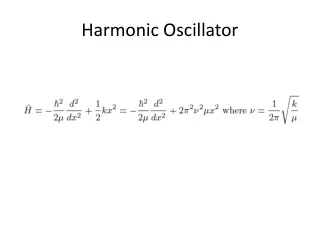
Harmonic Oscillator Reset energy scale U(q0)=0x := displacement from equilibrium m:= reduced mass Stationary Schrödinger Equation x= D Symmetric potential Harmonic Oscillator Energy eigen states y(x) : spatially either symmetric or asymmetric
Harmonic Oscillator: Asymptotic Behavior Asymptotic boundary conditions (y(x) in classically forbidden region)? x2 k2/l k2« l2x2 Harmonic Oscillator solved app. by Gaussian decay of wf in forbidden region, faster for heavy particles (m) and steep potential (c) . For HCL: l ~ 84 Å-2
Harmonic Oscillator Eigen Value Equation Trial: =exact solution for Harmonic Oscillator Found one energy eigen value and eigen function (= ground state of qu. oscillator)
Hermite’s DEqu. Harmonic Oscillator: Hermite’s Differential Equ. All asymptotic: Trial function Harmonic Oscillator Asymptotic behavior: H(x) not exponential H = finite power series
all =0 Solving with Series Method Hermite’s DEqu. Asymptotic behavior H(x) not exponential H= finite power series Discrete EV spectrum, count states n=,0, 1,…ai from differential equ. Harmonic Oscillator
w Energy Spectrum of Harmonic Oscillator Recursion relations for aiterminate at i = n i = even or i = odd. Harmonic Oscillator Energy eigen values of qu. harmonic oscillator
E3 n=3 E2 n=2 E1 n=1 E0 x= D n=0 Harmonic Oscillator Level Scheme Equidistant level scheme unbounded, n HCl Zero-point energy +1: absorption -1: emission Elm. E1 transitions: D n = ± 1 D Harmonic Oscillator Absorption and emission in infra-red spectral region
z r m2 L q f m1 J=4 J=4 J=4 J=3 J=3 J=3 J=2 J=2 J=2 J=1 J=1 J=1 n = 1 n = 0 n = 2 J=0 J=0 J=0 Rot-Vib Spectra of Molecules Assume independent rot and vib neglect centrifugal stretching Very different energy scales Selection rules for elm transitions: Harmonic Oscillator rotationalband vibrationalband Vibrational transition change in change in angular momentum
z r m2 L q f m1 Rot-Vib Spectra of Molecules Assume independent rot and vibneglect centrifugal stretching J2 J1 Rot-vib absorption/emission branches Harmonic Oscillator
HOsc-Wave Functions: Hermite’s Polynomials Definite parity p=+1 ,p=-1 Harmonic Oscillator
Normalization Oscillator Eigenfunctions Unnormalized: n=4 n=3 n=2 n=1 n=0 x Harmonic Oscillator All have definite parity, spatial symmetry. n = # of nodes
Calculating Expectation Values Mean square deviation from equilibrium bond length HCl MathCad rendition: Deviation from equilibrium bond length Harmonic Oscillator
End of Section Harmonic Oscillator
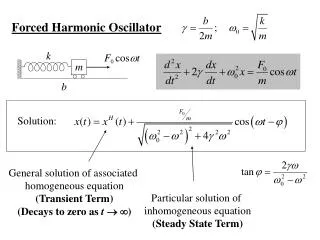
Harmonic Oscillator: General Solution Harmonic Oscillator
z z z z z z y r m2 m2 m2 m2 q L R q f f f f f x r r r r m m1 m1 m1 m1 R R R L L L L z m +4 +3 a +2 +1 0 -1 -2 -3 -4 Drawing Elements L=4 a Harmonic Oscillator