Download

1 / 10
100 likes | 210 Vues
This project aims to develop a superior and more affordable alternative to the current KCI wound bag system, utilizing suction techniques or other methods to enhance wound healing. The objectives include improving circulation, removing necrotic tissue, eliminating excess exudate, eradicating infections, and maintaining a clean, moist wound environment. Current techniques, such as Vacuum Assisted Closure (V.A.C.) Therapy, face issues like skin damage and high costs. Our innovation seeks to minimize production costs while providing a high-quality solution to benefit patients and healthcare providers.

E N D
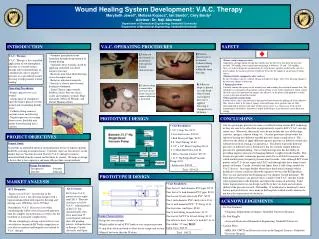
Wound Healing System Development Group 27 Cary Berdy Marybeth Jewell Melissa Kopacz Ian Sando Advisor: Dr. Naji Abumrad
Objective “Develop a better, less expensive method than the current KCI wound bag system to assist in wound healing. The method may involve suction techniques or other methods to assist in the partial surface closure of wounds.” - Dr. Naji Abumrad
Goals of Topical Wound Treatment • Provide adequate circulation/oxygenation • Remove necrotic (dead) tissue • Eliminate large amounts of exudate • Eradicate clinical infection • Obliterate dead spaces or voids • Maintain a clean, moist wound surface
Current Healing Technique • Vacuum Assisted Closure (V.A.C.) Therapy • Promote granulation tissue formation through the promotion of wound healing. • Uniformly draw wounds closed by applying controlled, localized negativepressure. • Remove interstitial fluid allowing tissue decompression. • Remove infectious materials. • Provide a closed, moist wound healing environment. • Treats Chronic open wounds, Diabetic ulcers, Pressure ulcers, Acute and traumatic wounds, Flaps and grafts, Dehisced Wounds, and Partial Thickness Burn
Standard V.A.C. Operating Procedure • Foam is placed over or in wound • A large piece of transparent tape/ dressing is placed over the wound and surrounding healthy tissue • Catheter tubing connects vacuum source and dressing • Negative pressure of vacuum draws excess fluid that may hinder wound healing into a canister • Dressing changed every 48 hours
Disadvantages of Current Devices • Adhesive Polyvinyl Dressing/Seal damages fragile skin when removed • Foam/ Dressing has caused irritation • Costs: • Daily costs of V.A.C. exceeds that of the traditional, twice-a-day dressing changes with a topical antimicrobial with regard to dressing and nursing costs ($282/day versus $75/day). • However, V.A.C. decreases costs when considering the added costs of increased operative time for complex reconstructions as well as for the treatment of associated complications. • Why not decrease both?
Ethics • Meets safety requirements and health standards • Easy to operate =>minimal training required • Reduce healing time => hospital stay duration minimized
Market Analysis • We intend to investigate material/ production costs of current products • Our design should minimize production costs while producing a quality product • Introduce competition into the market
References • http://www.kci1.com/products/vac/vac/index.asp • http://64.233.167.104/search?q=cache:GuzsoyZXpbQJ:www.health.gov.on.ca/english/providers/program/mas/reviews/docs/recommend_vac_121604.pdf+V.A.C.+Therapy+costs&hl=en • http://64.233.167.104/search?q=cache:STFs2zx-PvUJ:www.plasticsurgery.org/PSF/PSFHOME/educate/abstracts/Wednesday/B/1057-1103.htm+V.A.C.+Therapy+costs&hl=en • http://www.nursing.uiowa.edu/sites/chronicwound/index.htm