Exploring Morality and Religion: Divine Command vs. Natural Law Theories
140 likes | 200 Vues
Delve into the debate on whether morality depends on religion, examining Divine Command and Natural Law theories, their implications, and the challenges they face in modern contexts.


Exploring Morality and Religion: Divine Command vs. Natural Law Theories
E N D
Presentation Transcript
Two Religiously Dependent Positions • Divine Command Theory • Natural Law Theory
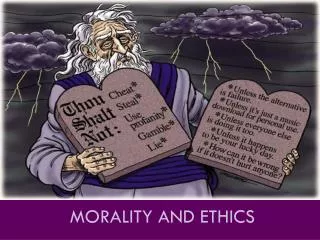
Divine Command Theory Moral = "that which God commands"
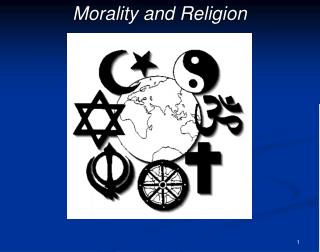
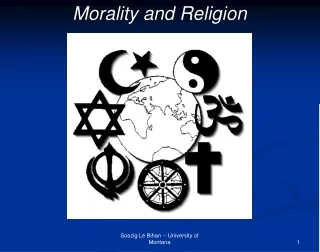
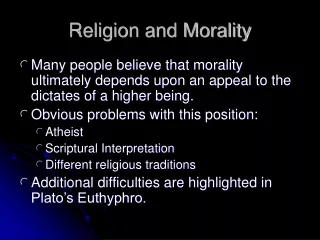
2 Problems for Divine Command Theory • Diversity: different religions, sects of the same religion, interpretations, atheists, agnostics. • Implications of what follows from the idea itself.
Assume that the statement "Moral is that which God commands" is TRUE. • What questions does this raise about the nature of morality?
Two Questions • Is something moral because God commands it? • Or. . . • Does God command something because it is moral?
Implication of the First Question • God commands • God could have commanded otherwise • God's commands are arbitrary
Implications of the Second Question • God only commands good things • Gods commands are thus constrained by morality. • There is a source of morality independent of God. • Therefore, God is not the source of morality...why do we need God?
Religious morality is ultimately based on faith and not reason. • (Problematic if we want a morality that is justified to all people)
3 Main Components • The world has a rational order with values and purposes built into it. • Laws of nature not only describe the way things are but the way things ought to be. • Right and wrong are derived from reason.
Problems with Natural Law Theory • Theory is at odds with current scientific theories of the nature of the universe. • Hume: You can't get an 'ought' from an 'is'. • Believers are not in any privileged moral position relative to non-believers.