Advances in High-Current ERL Cryomodule Development Across Global Collaborations
This document outlines the collaborative development of an improved High-Current Energy Recovery Linac (ERL) cryomodule involving five institutions: ASTeC (UK), Cornell University, Stanford University, Lawrence Berkeley Laboratory, and FZD Rossendorf (Germany). Key design goals include achieving an accelerating gradient exceeding 20 MV/m with high quality factors. Challenges such as effective higher-order mode damping, microphonics sensitivity, and input power delivery are identified for resolution. The cryomodule's performance will be validated on the ALICE and Cornell ERL injector facilities.

Advances in High-Current ERL Cryomodule Development Across Global Collaborations
E N D
Presentation Transcript
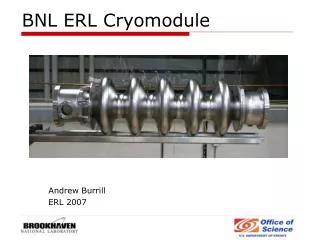
Improved High Current ERL Cryomodule 5 collaborating institutes: • ASTeC (UK): Cavity, coupler, tuner, cryogenics, integration, assembly • Cornell University (USA): Cavity, tuner, coupler, absorber, absorber, integration) • Stanford University (USA): Tuner, coupler, assembly • Lawrence Berkeley Laboratory (USA): Cavity • FZD Rossendorf (Germany): Coupler, tuner, integration)
Cryomodule Goals • Design requirements: • Eacc > 20 MV/m @ Qo > 1010 • Qext 1 x 10⁷ to 1 x 10⁸ • Couplers capable of up to 25 kW CW SW • Large HOM damping capability • Issues to be resolved include: • Effective HOM Damping (up to 200W/cavity) • Microphonics sensitivity (< 25 Hz peak) • Fast Tuning (microphonics compensation) • Input Power Delivery (25 kW CW SW) • Cryomodule Design (< 2.5 W static loss) • A 2-cavity cryomodule to be validated with beam: • On ALICE in 2009 • On Cornell ERL injector in 2010
Cryomodule Evolution 2 x 9-cell 1.3 GHz cavity ERLP Module 10 kW CW fixed coupling FPC