Understanding Microbial Activity and Biogeochemistry in Arctic Sea Ice Throughout the Annual Cycle
30 likes | 139 Vues
While much of our knowledge about Arctic sea ice biology is focused on summer conditions, microbial activity occurs all year round. Bacterial communities are distributed throughout the ice, heavily influenced by environmental gradients at the ice's top and bottom. Critical processes such as DMSP production, EPS formation, and calcium carbonate selection impact the ecosystem's chemistry and physics. This study emphasizes the need for a comprehensive understanding of the microbial community composition and physiological state, which is crucial for establishing baseline biogeochemical conditions in a changing Arctic.


Understanding Microbial Activity and Biogeochemistry in Arctic Sea Ice Throughout the Annual Cycle
E N D
Presentation Transcript
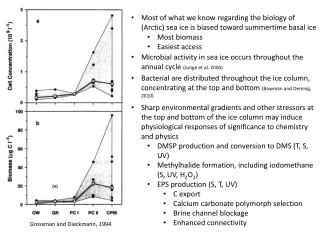
Most of what we know regarding the biology of (Arctic) sea ice is biased toward summertime basal ice • Most biomass • Easiest access • Microbial activity in sea ice occurs throughout the annual cycle (Junge et al. 2004) • Bacterial are distributed throughout the ice column, concentrating at the top and bottom (Bowman and Deming, 2010) • Sharp environmental gradients and other stressors at the top and bottom of the ice column may induce physiological responses of significance to chemistry and physics • DMSP production and conversion to DMS (T, S, UV) • Methylhalide formation, including iodomethane (S, UV, H2O2) • EPS production (S, T, UV) • C export • Calcium carbonate polymorph selection • Brine channel blockage • Enhanced connectivity Grossman and Dieckmann, 1994
Biologically active ice is more connective than sterile ice • Implications for permeability of gas • Implications for nutrient renewal • Implications for ice strength • Limitations of laboratory study • EPS varies in concentration and composition • At this time don’t know how changing EPS will impact the properties of sea ice in the future Community composition Physiological state Physical and chemical impact Krembs, Eicken, and Deming, 2011
Integrating into MOSAiC – Establishing a baseline for predictive (physio)biogeochemistry • Given a set of chemical and physical conditions who is present, how many are there, and what are they doing that feeds back to the initial conditions? • Basic biology is lacking for the central Arctic, little effort or equipment is required for a long time series of basic parameters • In addition at key time points detailed community composition* should be assessed in combination with rate measures and flux measures Krembset al. 2002 + +