Introduction to AngularJS: A Comprehensive Lunch & Learn Session
190 likes | 300 Vues
Join us for a Lunch & Learn session to explore AngularJS, a dynamic JavaScript framework maintained by Google. In this interactive session, we’ll cover the key concepts of AngularJS, including directives, controllers, scopes, and modules. Discover how AngularJS facilitates the creation of single-page applications through its unique features like two-way data binding and dependency injection. Enjoy some pizza and drinks while learning about this powerful framework and how it can help optimize your web applications. Let’s connect and share insights about our experiences!


Introduction to AngularJS: A Comprehensive Lunch & Learn Session
E N D
Presentation Transcript
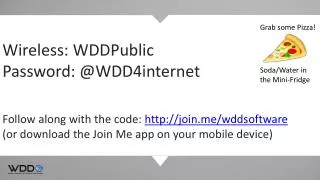
Wireless: WDDPublic Password: @WDD4internet Follow along with the code: http://join.me/wddsoftware (or download the Join Me app on your mobile device) Grab some Pizza! Soda/Water in the Mini-Fridge
Introductions • What is your name? • What Company are you from? • Tell us a little bit about what your company does! • What is your role at your company?
AngularJS Discussion / Lunch & Learn / Demo
What Is AngularJS? • A JavaScript MVC/MVVM/“MVW” (model-view-whatever) framework for building single-page web apps • Maintained by Google & development community • Licensed under the MIT license • Supports modern browsers including Internet Explorer 8+ (IE 9+ as of AngularJS 1.3)
What Is AngularJS? • An application framework, not “just” a library or toolkit • Declarative UI construction via extended HTML markup and two-way data binding • DOM manipulation separated from application logic • Emphasis on testability
Key AngularJS Concepts • Directive: View construction & DOM manipulation • Controller: Application logic (model) • Scope: “Glue” between the controller and the view (viewmodel) • Module: Code organization and unit of re-use • Dependency Injection: Automatically manage object dependencies
Directives • Declarative UI construction – the “V” in MVW • Appear in HTML as new elements & attributes • Attach functionality to DOM elements • Provide two-way data binding • Provide for DOM manipulation(for example, repetition and conditional inclusion of DOM elements)
Scopes • Think “ViewModel” in MVVM architecture • Expose the domain model to the view • Provide both data and functionality • The domain model is just POJO (plain old JavaScript objects) • There are many scopes in an AngularJS application, arranged in a hierarchy
Controllers • Responsible for initializing the scope object • Populate the scope with initial model values • Augment the scope with functions that can be called by the UI
Modules • Keep global namespace clean • Aid in code organization and testing • Factor out common functionality for re-use between applications • Are assembled into an AngularJS application via dependency injection
Dependency Injection • Describes dependencies among objects declaratively • Avoids tight coupling between objects; facilitates re-use and testing • The AngularJS injector finds and wires up collaborating objects, referred to as “services” • Watch out if you use JavaScript minification: use annotations to specify dependencies
Additional AngularJS Features • Testability: Unit testing (Jasmine, Karma runner) and end-to-end testing (Protractor) • Multiple views and routing: view selection based on URL (ngRoute module; UI-Router module from AngularUI project) • Eventing system via scope hierarchy • Filters (formatting) and parsers (validation) for two-way data binding
AngularJS Resources • Home page: angularjs.org • The ng-book by Ari Lerner: www.ng-book.com • Book: Mastering Web Application Development with AngularJS by Pawel Kozlowski and Peter Bacon Darwin • Video tutorials: egghead.io • Useful modules: angular-ui.github.io