Comprehensive Guide to Primary School Mathematics: Addition, Subtraction, Multiplication, and Division
170 likes | 288 Vues
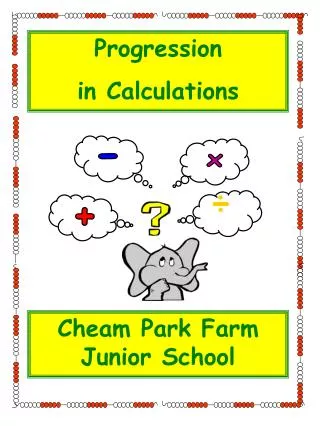
This guide outlines the methodologies used in teaching mathematics from Year 3 to Year 6, focusing on addition, subtraction, multiplication, and division. It covers partitioning methods for addition, including increasing numbers and decimals. Subtraction techniques, such as the empty number line and compact methods, are introduced as students progress. Multiplication is taught using arrays, grids, and more compact methods for larger numbers. Division concepts include chunking and the use of number lines. Additional educational resources are provided to enhance learning.


Comprehensive Guide to Primary School Mathematics: Addition, Subtraction, Multiplication, and Division
E N D
Presentation Transcript
Calculations in mathematics Things are different now!
addition • Year 3 Partitioning method is used – for example 37 + 24 = 61 30 + 20 = 50 7 + 4 = 11
Year 4 Partitioning used for increasingly large numbers –eg 2417 + 3524 = 5941 2000 + 3000 = 5000 400 + 500 = 900 10 + 20 = 30 7 + 4 = 11 Year 4 continued Vertical layout introduced – eg 47+ 368+ 76493 110 700 13 150 123 11 861 Addition
Addition • Year 5 & Year 6 As for year 4 but extended to include decimals with partitioning – eg 7.6 + 5.8 = 13.4 7 + 5 = 12 0.6 + 0.8 = 1.4
Addition • Y6 More able children introduced to compact and efficient method at the appropriate time – eg 1 7 9 + 2 1 . 7 + 21 31 62 21 . 5 4 1 54 4 . 2
Subtraction • Year 3 Empty number line method is used – eg 95 - 33 = 62 7 50 5 33______________________________95 40 90
Years 4 – 6 The empty number line continues to be used in these year groups. The children are encouraged to develop increasingly refined and efficient methods of using the number line. Subtraction
Subtraction • Year 6 Compact and efficient method introduced at appropriate time for more able children – eg 6 6 4 7 16 – 5 7 . 12 - 1 3 93 4 . 5 3 3 7 2 2 . 7
Multiplication • Year 3 Arrays are used to develop understanding. Children begin to use partitioning – eg 16 x 5 = 80 10 x 5 = 50 6 x 5 = 30
Multiplication • Year 4 Children continue to partition but grid method is introduced – eg 6 x 32 = 192 X 30 2 6 180 12
Multiplication • Years 5 & 6 Grid method used with larger numbers and decimals – eg 27 x 15 = 4051.23 x 45 = 55.35 X 20 7 X 1 0.2 0.03 10 200 70 = 270 40 40 8 1.249.2 5 100 35 = 135 5 5 1 0.15 6.15 405 55.35
Multiplication • More compact method for grid introduced where appropriate: 26 x 37 20 x 30 = 600 20 x 7 = 140 6 x 30 = 180 6 x 7 = 42 962
Multiplication • Y6 Compact and efficient method introduced when appropriate for more able children – eg 3 2 x 2 4 x 4 . 8 x 1 62 22 3 1 9 2 4 8 14 . 4 41 8 0 5 2 8
Division • Year 3 and 4 Chunking method used along with visual model including remainders – eg 16 ÷ 4 = 436 ÷ 10 = 3 Rem 6 ….. . . . . . . . . . …. . . . . . . . . . . ….. . . . . . . . . . …. . . . . . .
Division • Years 4, 5 & 6 These methods can also be used with a number line – eg 120 ÷ 9 = 13 rem 3 0____________________________90_____117__120 10x9 3x9
Year 4, 5 & 6 The concept of chunking is still used but method becomes numerical rather than pictorial. Several strategies are used, all of which rely on good knowledge of times tables! 2. 265 ÷ 13 = 20 rem 5 13 265 130 (10 x 13) 135 - 130 (10 x 13) 5 Division 93 ÷ 6 = 15 rem 3 (16.5) I know that 10 x 6 = 60 and 5 x 6 = 30 so 15 x 6 = 90
Useful websites www.supermathsworld.com Outer space-related activities on wide range of topics – annoying music though! www.educationcity.com Log-in: 815western Password: school Go to ‘Curriculum Map’ Maths Choose year group then specific maths area www.bbc.co.uk/schoolradio/maths/mathschallenge.shtml Download radio programmes containing a variety of mental maths questions www.subtangent.com More able children – investigative challenges nrich.maths.org/public Go to ‘Stage 1 and 2’ down left-hand side for the latest mathematical challenges, graded by difficulty with stars. woodlands-junior.kent.sch.uk/maths Allsorts of interactive activities. Well indexed.