Fostering a Knowledge-Based Economy in Singapore: Strategies and Initiatives
140 likes | 268 Vues
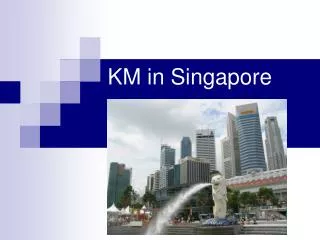
Singapore has embraced the Knowledge-Based Economy (KBE) as a vital driver of growth, employment, and wealth creation across all sectors. Initiatives from the public and private sectors aim to enhance knowledge management (KM) practices, supported by local universities offering specialized programs for knowledge professionals. The government’s e-Government vision emphasizes its commitment to improving services for citizens, while recent KM conferences illustrate a shift toward a balanced approach that integrates strategic planning, people management, processes, and technology. Observations indicate a growing receptiveness to KM in Singapore organizations.


Fostering a Knowledge-Based Economy in Singapore: Strategies and Initiatives
E N D
Presentation Transcript
Knowledge Based Economy • One in which the production, distribution and use of knowledge are the main drivers of growth, wealth creation, and employment for all industries. OECD (1996)
Moving Towards KBE • Singapore introduced KM initiatives in public and private sectors • Local universities introduced new programs for information and knowledge professionals to support the KM initiatives
Global Information Technology Report • measure the degree of preparation of a nation to participate in and benefit from ICT developments
Innovation- Gross Domestic Expenditure on R&D as a % to GDP (GERD) • Taiwan 1.98% • Singapore 1.80% • Hong Kong 0.36% Hong Kong Institution of Science (HKIS) , 2000
E-Government • The vision is to be a leading eGovernment to better serve Singapore and Singaporeans in the new knowledge-based economy 2000 Singapore Government
Asian Most Admired Knowledge Enterprises (MAKE) • Japan (Kao, Nissan Motor, Toyota Motor) • Taiwan (Taiwan semiconductor) • S. Korea (POSCO, LG Electronics, Samsung, SDS) • Singapore (Singapore Airlines) • India (Eureka Forbes, Wipro, TCS, Infosys)
Ministry of Manpower • Manpower planning and skills development • Managing foreign manpower • Promote quality workplace
Blended KM Approach • Able to see the “whole” from strategic planning • People elements- motivation, system thinking, change management and organization restructuring • Process elements- process redesign and improvement • Technology elements- enabling IT infrastructure
Influence of Australia Knowledge Management Model (AS 5037)
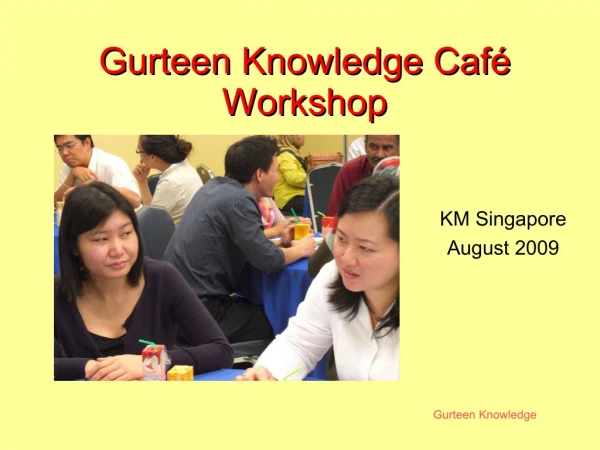
KM Conference and Workshop • Re-Assessing the Performance of KM as a Functional Business Tool, Jul 2006 • Strategic Law Firm Management Using Best Practice, Aug 2006 • Knowledge Management Asia 2006 , Asia's largest knowledge management conference, Nov 2006
Observations • Singapore government’s vision towards a knowledge based economy & e-government has prepared the ground for KM • Singapore organizations are more receptive to KM • Early KM initiatives were IT led, such as document management systems • KM is moving towards a more balanced approach