Describing People and Places in Spanish: A Week of Learning Activities
This week's lesson focuses on using adjectives in Spanish to describe people and places. Students will engage in various activities, including creating sentences about themselves and others, working with vocabulary from their textbook, and practicing speaking with partners. The objectives include using physical descriptions and nationalities while honing written and spoken skills. By the end of the week, students will confidently use descriptive adjectives to give facts and opinions. Activities include pre-writing, reading vocabulary, and interactive discussions.

Describing People and Places in Spanish: A Week of Learning Activities
E N D
Presentation Transcript
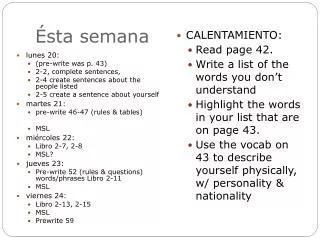
Éstasemana • lunes 20: • (pre-write was p. 43) • 2-2, complete sentences, • 2-4 create sentences about the people listed • 2-5 create a sentence about yourself • martes 21: • pre-write 46-47 (rules & tables) • MSL • miércoles 22: • Libro 2-7, 2-8 • MSL? • jueves 23: • Pre-write 52 (rules & questions) words/phrases Libro 2-11 • MSL • viernes 24: • Libro 2-13, 2-15 • MSL • Prewrite 59 • CALENTAMIENTO: • Read page 42. • Write a list of the words you don’t understand • Highlight the words in your list that are on page 43. • Use the vocab on 43 to describe yourself physically, w/ personality & nationality
Calentamiento Complete your pre-write from page 43 • Read page 42 & make a list of words you don’t know. • Highlight the words you don’t know that are listed on page 43 • read the conversation out loud with a partner • Read the vocabulary out loud with a partner
Theme: Describing people & places • Objective & Big Picture: Adjectives allow students to describe things & give facts/opinions about people and things • TSWBAT: describe themselves and another person using physical adjectives and nationality. • Language Objective: Say a sentence using two adjectives in Spanish to describe themselves
Adjetivosdescriptivos y adjetivos de nacionalidad Descriptive and nationality adjectives ¡Arriba! Capítulo 2 READ pages 40-41
Rubio/a • Blonde • Moreno/a • Dark hair/complexion • Joven • young • Viejo/a • Old • Alto/a • Tall • Bajo/a • Short • Pobre • Poor • Rico/a • Rich • Flaco/a • Thin • Gordo/a • Fat • Nuevo/a • New
Bonito/a • Pretty • Guapo/a • Handsome/good-looking • Feo/a • Ugly • Grande • Big • Pequeño/a • small • Trabajador/a • Hard-working • Perezoso/a • lazy
Asking / Answering about descriptions. • ¿Cómoeres (tú)? • How are you physically/characteristically? • What are you like? • Soy _____. • I am ____. • Soy simpático. • ¿Cómoesél-Juan/ella-María/usted? • What is he/she/you formal like? • Éles _____./Ella es _____./Ustedes ____. • He/She/You formal is _____/
Los países y lasnacionalidades • La Argentina • argentino/a • El Canadá • canadiense • Chile • chileno/a • Colombia • colombiano/a • Cuba • cubano/a • La RepúblicaDominicana • dominicano/a • El Ecuador • equatoriano/a • España • español/a
Panamá • Panameño/a • El Perú • Peruano/a • Puerto Rico • Puertorriqueño • El Salvador • Salvadoreño/a • Venezuela • Venezolano/a
¿De dóndeeres (tú)? • Where are you from? • Soy estadounidense. • Soy de los EstadosUnidos. • ¿De dóndeesShakira? • Ella es de Colombia. • Ella escolombiana.
Los lugares (the places) • La capital • The capital • El país • The country • La ciudad • The city • El pueblo • The town
Las personas • El amigo/la amiga • The friend • El muchacho/la muchacha • The boy/the girl • El padre • The father • La madre • The mother • Los padres • The parents • The fathers • El hombre • The man • La mujer • The woman • El chico • The boy • La chica • The girl
adverbios • Ahora • Now • Ahoramismo • Right now • También • Also • Tarde • Late • Temprano • early Conjunciones/conjunctions • Pero • But • Porque • Because • Assignment: • Libro (42-43: 2:2-2-5)