
Classification Procedure for Transporting Aquatic Environmental Hazardous Substances
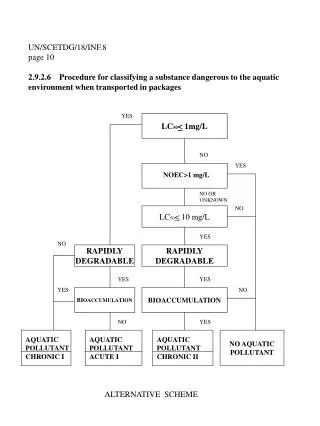
This document outlines the procedure for classifying substances hazardous to the aquatic environment during transport. It specifies criteria such as lethal concentration (LC50) values, no observed effect concentration (NOEC) levels, biodegradability, and bioaccumulation potential. Substances classified according to these parameters can be considered aquatic pollutants under various categories, including acute and chronic toxicity. The classification process is essential for ensuring safe handling and regulatory compliance in the transport of hazardous materials.

Classification Procedure for Transporting Aquatic Environmental Hazardous Substances
E N D
Presentation Transcript
UN/SCETDG/18/INF.8page 102.9.2.6 Procedure for classifying a substance dangerous to the aquatic environment when transported in packages YES LC50< 1mg/L NO NOEC>1 mg/L YES NO OR UNKNOWN NO LC50< 10 mg/L YES NO RAPIDLY DEGRADABLE RAPIDLY DEGRADABLE YES YES YES NO BIOACCUMULATION BIOACCUMULATION NO YES AQUATIC POLLUTANT CHRONIC I AQUATIC POLLUTANT ACUTE I AQUATIC POLLUTANT CHRONIC II NO AQUATIC POLLUTANT ALTERNATIVE SCHEME