Best Practices in Developmental Education: A Research-Based Approach
This presentation by Ruth Dalrymple and Marilyn Mays highlights effective organizational, administrative, and instructional practices in developmental education based on Hunter R. Boylan's research. It discusses the importance of centralization, collaboration, comprehensive support services, systematic evaluation, and faculty development. Key findings include the need for well-defined missions and goals, effective assessment and placement, and innovative funding for programs. This research emphasizes successful strategies essential for enhancing developmental education at Texas colleges and universities.

Best Practices in Developmental Education: A Research-Based Approach
E N D
Presentation Transcript
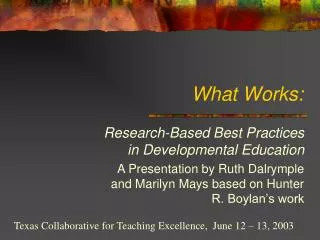
What Works: Research-Based Best Practices in Developmental Education A Presentation by Ruth Dalrymple and Marilyn Mays based on Hunter R. Boylan’s work Texas Collaborative for Teaching Excellence, June 12 – 13, 2003
Organizational, Administrative, and Institutional Practices • Centralization of Program Activities • Coordination of Dev Ed Courses and Services • Management of Faculty&Student Expectations of Dev Ed • Collaboration with Other Academic Units • Establishment of Mission, Goals, and Objectives
Organizational, Administrative, and Institutional Practices • Identification of Dev Ed as an Institutional Policy • Provision of Comprehensive Support Services • Funding for Innovative Program Development • Integration of Dev Ed and Community Outreach
Program Components • Assessment/Placement • Systematic Program Evaluation • Formative Evaluation for Program Improvement • Professional Development • Tutoring • Professional Associations
Program Components • Adjunct Faculty • Student Performance Monitoring by Faculty and Advisors • Developmental Philosophy as a guide to program activities • Classroom/Lab Integration
Instructional Practices • Learning Communities • Varied Instructional Methods • Supplemental Instruction • Testing Opportunities • Technology (moderation) • Feedback • Mastery Learning
Instructional Practices • Linking Dev to Academic Courses • Share Instructional Strategies • Critical Thinking • Learning Strategies • Active Learning • Classroom Assessment Techniques
Best Practices • Study from NCDE for THECB • “An Evaluation of Developmental Education at Texas Colleges and Universities” • Boylan and Saxon • Institutions identified as most successful in using dev ed to prepare students for TASP and college-level courses • Called “Best Practices”
Level One • Strongly supported by the survey • Research and literature available • Many experts available
Level Two • Supported by study • Some literature and expert opinions
Level Three • Little or no support from literature • Still may be used to characterize successful dev programs in Texas
Survey and Texas • Over 4000 faculty/administrators targeted • 13% responded • 94% of institutions represented • Concerns (low participation, access to web) • Biggest Concern: overstating adoption of best practices
Preliminary Results • Common Weaknesses • Lack of integration with campus outreach services • Lack of grant funds • Lack of centralized organization for dev ed • Professional Development for faculty • Tutor training
Preliminary Results • Dev Ed faculty not professionals in area/not trained • Infrequent testing • Lack of forums to share ideas • Failure to implement strategies
Preliminary Results • Strengths • Assessment/Placement • Adoption is proceeding (slowly)
Mathematics Developmental Education in Texas Institutions of Higher Education Survey of Best Practices Adoption January 2003 Texas Higher Education Coordinating Board
# Statement Strongly Disagree Disagree Agree Strongly Agree Organization and Administration 1. We have a centralized developmental education program. 13.7% 17.7% 28.4% 40.1% 2. We have a highly coordinated developmental education program 5.7% 19.4% 38.0% 37.0% 3. Expectations for developmental education are well-managed 5.2% 13.9% 43.0% 38.0% 4. There is collaboration between developmental education and other campus units. 6.2% 18.6% 44.0% 31.3%
5. Our developmental program has a clearly defined statement of mission, goals, and objectives. 4.5% 10.7% 35.1% 49.7% # Statement Strongly Disagree Disagree Agree Strongly Agree 6. Developmental education is an institutional priority. 6.7% 13.5% 38.6% 41.1% Organization and Administration 7. The institution provides comprehensive services in support of developmental education. 4.2% 11.0% 40.6% 44.1% 8. Grant funds are used to support innovation in developmental education. 9.4% 25.6% 41.5% 23.6% 9. Developmental education is integrated with campus outreach services in the community. 11.0% 36.1% 38.6% 14.2%
10. Assessment is mandatory for all entering students. 1.5% 3.3% 25.4% 69.7% # Statement Strongly Disagree Disagree Agree Strongly Agree 11. Placement in courses is mandatory based on assessment. 2.5% 5.2% 30.3% 62.0% Program Components 12. A systematic plan is in place for the evaluation of developmental education courses and services. 4.3% 19.2% 37.6% 38.8% 13. Formative evaluation is used by developmental educators to refine and improve courses and services. 5.9% 16.1% 48.3% 29.8% 14. Professional development for developmental educators is consistently supported. 7.0% 16.7% 38.0% 38.3%
15. Tutoring is provided to developmental students in all basic skills subjects. 2.3% 5.9% 28.9% 62.9% # Statement Strongly Disagree Disagree Agree Strongly Agree 16. Tutors working with developmental students are required to participate in training activities. 10.0% 28.3% 38.8% 22.9% Program Components 17. Developmental educators are regularly involved in their professional associations. 6.0% 24.2% 44.1% 25.6% 18. Adjunct faculty are treated as an important resource for developmental education. 5.9% 11.4% 37.6% 45.2% 19. Student performance is systematically monitored by faculty and advisors. 3.0% 12.0% 41.8% 43.1%
20. A written philosophy statement guides the provision of developmental education courses and services. 4.7% 19.4% 39.3% 36.6% # Statement Strongly Disagree Disagree Agree Strongly Agree 21. Classrooms and laboratories are well integrated. 6.5% 15.6% 41.1% 36.8% Program Components
22. Learning communities are provided for developmental students. 8.2% 35.1% 39.0% 17.7% # Statement Strongly Disagree Disagree Agree Strongly Agree 23. A wide variety of different instructional methods are used in developmental courses. 3.5% 13.9% 43.1% 39.5% Instructional Practices 24. Students are tested at least 10 times a semester in developmental courses. 12.4% 36.3% 29.4% 21.9% 25. Technology is used primarily as a supplement for instruction in developmental courses. 3.8% 11.4% 52.7% 32.1% 26. Feedback is frequently provided on a regular basis in developmental courses. 2.3% 9.4% 43.5% 44.8%
27. Mastery learning is a common characteristic of developmental courses. 5.0% 21.7% 42.8% 30.4% # Statement Strongly Disagree Disagree Agree Strongly Agree 28. Systematic efforts are made to link the content of developmental courses to the rest of the curriculum. 4.0% 15.4% 45.3% 35.3% Instructional Practices 29. Instructional strategies are regularly shared among developmental instructors in some systematic way. 9.4% 29.3% 40.6% 20.7% 30. Critical thinking is taught in all developmental courses. 5.0% 18.7% 46.5% 29.8%
31. Learning strategies are either embedded in developmental courses or taught as a separate course. 4.0% 11.9% 50.3% 33.8% # Statement Strongly Disagree Disagree Agree Strongly Agree 32. All developmental instructors regularly use active learning techniques in their courses. 4.3% 26.3% 43.3% 26.1% Instructional Practices 33. All developmental instructors regularly utilize Classroom Assessment Techniques in their courses. 7.0% 29.3% 44.5% 19.2%