Download
1 / 15
150 likes | 277 Vues
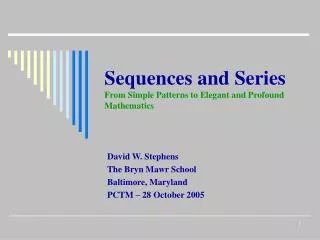
This introduction provides a comprehensive overview of sequences and series, including definitions, examples, and fundamental concepts. A sequence is an ordered list of numbers known as terms, characterized by their domain (position) and range (actual values). It can be finite or infinite. The general rule for sequences is explored, along with methods for graphing. The discussion extends to series, which are the sums of sequences, and the use of summation notation (sigma notation) for both finite and infinite series. Special formulas for calculating sums are also introduced.

E N D
Sequence: • A list of ordered numbers separated by commas. • Each number in the list is called a term. • For Example: Sequence 1Sequence 2 2,4,6,8,10 2,4,6,8,10,… Term 1, 2, 3, 4, 5 Term 1, 2, 3, 4, 5 Domain – relative position of each term (1,2,3,4,5) Usually begins with position 1 unless otherwise stated. Range – the actual terms of the sequence (2,4,6,8,10)
Sequence 1Sequence 2 2,4,6,8,10 2,4,6,8,10,… A sequence can be finite or infinite. The sequence has a last term or final term. (such as seq. 1) The sequence continues without stopping. (such as seq. 2) Both sequences have a general rule: an = 2n where n is the term # and an is the nth term. The general rule can also be written in function notation: f(n) = 2n
Write the first 6 terms of an=5-n. a1=5-1=4 a2=5-2=3 a3=5-3=2 a4=5-4=1 a5=5-5=0 a6=5-6=-1 4,3,2,1,0,-1 Write the first 6 terms of an=2n. a1=21=2 a2=22=4 a3=23=8 a4=24=16 a5=25=32 a6=26=64 2,4,8,16,32,64 Examples:
The seq. can be written as: Or, an=2/(5n) The seq. can be written as: 2(1)+1, 2(2)+1, 2(3)+1, 2(4)+1,… Or, an=2n+1 Examples: Write a rule for the nth term.
Example: write a rule for the nth term. • 2,6,12,20,… • Can be written as: 1(2), 2(3), 3(4), 4(5),… Or, an=n(n+1)
Graphing a Sequence • Think of a sequence as ordered pairs for graphing. (n , an) • For example: 3,6,9,12,15 would be the ordered pairs (1,3), (2,6), (3,9), (4,12), (5,15) graphed like points in a scatter plot * Sometimes it helps to find the rule first when you are not given every term in a finite sequence. Term # Actual term
Series • The sum of the terms in a sequence. • Can be finite or infinite • For Example: Finite Seq.Infinite Seq. 2,4,6,8,10 2,4,6,8,10,… Finite SeriesInfinite Series 2+4+6+8+10 2+4+6+8+10+…
Summation Notation • Also called sigma notation (sigma is a Greek letter Σ meaning “sum”) The series 2+4+6+8+10 can be written as: i is called the index of summation (it’s just like the n used earlier). Sometimes you will see an n or k here instead of i. The notation is read: “the sum from i=1 to 5 of 2i” i goes from 1 to 5.
Summation Notation for an Infinite Series • Summation notation for the infinite series: 2+4+6+8+10+… would be written as: Because the series is infinite, you must use i from 1 to infinity (∞) instead of stopping at the 5th term like before.
a. 4+8+12+…+100 Notice the series can be written as: 4(1)+4(2)+4(3)+…+4(25) Or 4(i) where i goes from 1 to 25. Notice the series can be written as: Examples: Write each series in summation notation.
Example: Find the sum of the series. • k goes from 5 to 10. • (52+1)+(62+1)+(72+1)+(82+1)+(92+1)+(102+1) = 26+37+50+65+82+101 = 361
Example: Find the sum. • Use the 3rd shortcut!