Download
1 / 1
10 likes | 140 Vues
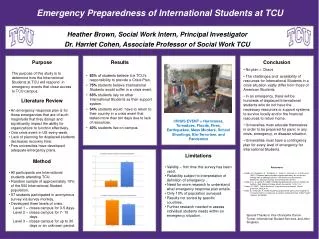
This study investigates how international students at Texas Christian University (TCU) would respond to emergencies disrupting campus access. With a sample of 57 students, the research highlights a significant reliance on peer support and the necessity for a robust crisis plan. Key findings reveal that 83% of participants believe TCU should provide a crisis plan, and a majority feel that international students would struggle in a crisis due to limited resources. The study emphasizes the urgent need for universities to develop comprehensive emergency plans to support the unique needs of international students.

E N D
Emergency Preparedness of International Students at TCU Heather Brown, Social Work Intern, Principal Investigator Dr. Harriet Cohen, Associate Professor of Social Work TCU • Purpose • The purpose of this study is to • determine how the International • Students at TCU will respond in • emergency events that close access • to TCU campus. • Literature Review • An emergency response plan is for • those emergencies that are of such • magnitude that they disrupt and • significantly impact the ability for • organizations to function effectively. • One crisis event in US every week. • Lack of planning for displaced students • decreases recovery time. • Few universities have developed • adequate emergency plans. • Method • All participants are International • students attending TCU. • Random sample of approximately 10% • of the 500 International Student • population. • 57 students participated in anonymous • survey via survey monkey. • Developed three levels of crisis: • Level 1 – closes campus for 3-5 days. • Level 2 – closes campus for 7- 10 • days. • Level 3 – closes campus for up to 30 • days or an unknown period. • Results • 83% of students believe it is TCU’s responsibility to provide a Crisis Plan. • 75% students believe International Students would suffer in a crisis event. • 63% students rely on other International Students as their support system. • 54% students would have to return to their country in a crisis event that lasted more than ten days due to lack of resources. • 40% students live on campus. CRISIS EVENT = Hurricanes, Tornadoes, Floods, Fires, Earthquakes, Mass Murders, School Shootings, Bio-Terrorism, and Pandemics • Conclusion • No plan = Chaos • The challenges and availability of resources for International Students in a crisis situation vastly differ from those of American Students. • In an emergency, there will be hundreds of displaced International students who do not have the necessary resources or support systems to survive locally and/or the financial resources to return home. • Universities must educate themselves in order to be prepared for panic in any crisis, emergency, or disaster situation. • Universities must have a contingency plan for every level of emergency for International Students. • References • Beaton, R., Stergachis, A., Thompson, J., Osaki, C., Johnson, C., & Charvat, S. • (2007). Pandemic policy and planning considerations for universities: • findings from a tabletop excercise. Biosecurity and Bioterrorism: • Biodefense Strategy, Practice and Science5(4), 327-34. • Calhoun, A., & Laford, R. (2000). Emergency planning for university health care • facilities. New England College Health Association, 13(4),1-13. • Cowen, S. (2007). Tulane University: From recovery to renewal. Liberal • Education, 93(3),6-18. • Rada, B., & Ramiah, K. (2005). Academic public health community responds to • hurricane Katrina: A showcase of systems and partnership. Public Health • Reports, 62,688-691. • Special Thanks to Vice Chancellor Darron Turner, International Student Services, and John Singleton • Limitations • Validity – first time this survey has been • used. • Reliability subject to interpretation of • definition of emergency . • Need for more research to understand • what emergency response plan entails. • Only 10% of population surveyed. • Results not sorted by specific • countries. • Further research needed to assess • individual students needs within an • emergency situation.