Discovering Kuwait: Geography, Culture, and Economy Insights
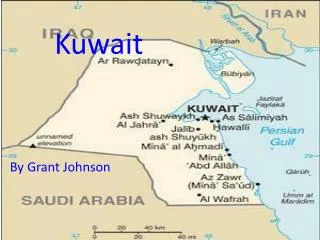
Kuwait, a flat desert nation of approximately 17,820 sq. km, is bordered by Iraq and Saudi Arabia. Its capital, Kuwait City, is home to 3.52 million people, comprising a diverse population of Kuwaitis and expatriates. This oil-rich country has a unique governance structure as a constitutional hereditary emirate. Education is free for citizens, and healthcare spending is robust, reflecting a commitment to citizen welfare. With intense summers reaching up to 120°F and mild winters, Kuwait offers a distinctive environment shaped by its geography and culture.

Discovering Kuwait: Geography, Culture, and Economy Insights
E N D
Presentation Transcript
Kuwait By Grant Johnson
Geography • 17,820 sq kilometers • 6,880 sq miles • It is about the size of New Jersey. • The capital is Kuwait City. • It is entirely flat desert. • Highest point is about 306 meters. • Summers are scorching hot roughly 108-120 degrees F. • Winters only last from about December to February. • Winters are about 50-80 degrees F with little rain.
General Facts • Kuwaiti 45%, other Arab 35%, South Asian 9%, Iranian 4%, other 7%. • Religion: Muslim estimated 85% (Sunni 70%, Shi'a 30%), large unknown amounts of Christians and Hindus and Buddhists. • Arabic is the official language, but English is common. • Roughly 3,520,000 people live in Kuwait. • About 1.06 million Kuwaiti citizens. • Close to 2.36 million non-Kuwaiti nationals. • Near 100,000 stateless people in Kuwait. • Population growth is about 3.549% annually. • It is actually called the State Of Kuwait. • GDP is about 136.5 billion dollars with a 2% annual increase.
Government • They have a Constitutional hereditary emirate. • They acquired their independence from the British on June 19, 1961. • Their constitution became official on November 11, 1962. • They have 3 branches of government: legislative, judicial, executive.
The green represents their land The black represents their battles The white represents their deeds The red represents their swords
Education • Compulsory from ages 6-14 • Education is free at all levels for Kuwaitis, including higher education. • Adult literacy (age 15 and over) is 93.3% for the total population. • Male 94.4% • Female 91% • They stay in school for about 12 years. • They spend 3.8% of GDP on education.
Health • To travel there you need to be vaccinated for yellow fever and Meningococcal. • Guys live for about 76 years. • Girls usually live to about 78 years. • They spent about 6.8% of GDP on healthcare.
Economics • Some natural resources in Kuwait are: petroleum, fish, shrimp, natural gas. • Almost half of the income in Kuwait comes from refining, extracting, and exporting petroleum. • 1 percent of the income comes from farming and other grown things. • Average per capita is 48,900 dollars. • 2.2% unemployment rate. • Kuwaiti dinars (KD) per US dollar = 0.2888
Relationship with U.S. • The U.S. opened a consulate in Kuwait in October 1951. • It turned into an embassy around 10 years later. • The U.S. government supports Kuwait's sovereignty, security, and independence. • In 1987 we were appointed freedom and protection in the gulf for boats and oil tankers. • We defended Kuwait when Iraq invaded them and in return they helped us watch Iraq and helped get U.S. troops and equipment out of Iraq.
Sharia • In Kuwait sharia still exists and is somewhat affecting the law. • If you murder someone, you must pay blood money to the family of a murder victim • Wine is illegal to consume and purchase. • unlawful sexual intercourse. • False accusation unlawful sexual intercourse. • Theft • Highway robbery
Human Rights • In 2007 Kuwait’s major problem was human trafficking. • Alcohol is illegal to drink in public and is not sold in the markets. • Eating in public during the daytime during Ramadan will lead to being fined and arrest. • Woman can not work between the hours of 8 pm and 7 am, unless in the medical profession, and they can not do anything that contravene with public morals like prostitution.
Current Events • The Kuwaiti borders were recently strengthened to decrease illegal immigration from Iran and Iraq.
Bibliography • "Kuwait." U.S. Department of State. Web. 30 Nov. 2011. <http://www.state.gov/r/pa/ei/bgn/35876.htm>. • "Flag of Kuwait." Wikipedia, the Free Encyclopedia. Web. 30 Nov. 2011. <http://en.wikipedia.org/wiki/Flag_of_Kuwait>. • https://www.cia.gov/library/publications/the-world-factbook/geos/ku.html • http://www.kuna.net.kw/NewsAgencyPublicSite/HomePage.aspx?Language=en


![Dictée for Week 15 [ c = k , qu = k , k = k ]](https://cdn2.slideserve.com/5052370/dict-e-for-week-15-c-k-qu-k-k-k-dt.jpg)