Reusing Real-Time Systems Design Experience Through Modelling Patterns
This paper discusses innovative methodologies for reusing real-time systems design, focusing on a systematic approach using modeling patterns. We introduce the POOSL modeling language for formal definitions, along with SHESim for model creation and simulation, and Rotalumis for property evaluation. Key components analyzed include scheduling, resource management, and task characterization. Our findings show that these modeling patterns facilitate the easy construction of correct models, enabling efficient exploration of design space while accounting for typical uncertainties in real-time systems.

Reusing Real-Time Systems Design Experience Through Modelling Patterns
E N D
Presentation Transcript
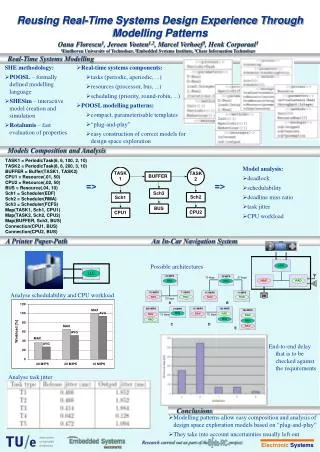
ElectronicSystems Reusing Real-Time Systems Design Experience Through Modelling Patterns Oana Florescu1, Jeroen Voeten1,2, Marcel Verhoef3, Henk Corporaal1 1Eindhoven University of Technology, 2Embedded Systems Institute, 3Chess Information Technology Real-Time Systems Modelling SHE methodology: • POOSL – formally defined modelling language • SHESim – interactive model creation and simulation • Rotalumis – fast evaluation of properties • Real-time systems components: • tasks (periodic, aperiodic, ...) • resources (processor, bus, ...) • scheduling (priority, round-robin, ...) • POOSL modelling patterns: • compact, parameterisable templates • “plug-and-play” • easy construction of correct models for design space exploration Models Composition and Analysis Model analysis: • deadlock • schedulability • deadline miss ratio • task jitter • CPU workload => => A Printer Paper-Path An In-Car Navigation System Possible architectures Analyse schedulability and CPU workload End-to-end delay that is to be checked against the requirements Analyse task jitter Conclusions • Modelling patterns allow easy composition and analysis of design space exploration models based on “plug-and-play” • They take into account uncertainties usually left out Research carried out as part of the project.