Download
1 / 10
110 likes | 267 Vues
This lecture covers essential concepts in number theory, including the Quotient-Remainder Theorem and the definitions of floor and ceiling functions. We explore direct proofs, counterexamples, and the technique of division into cases to establish conclusions. Key examples illuminate these theories, such as proving properties of integers based on their divisibility by specific numbers. By the end of this lecture, students will have a solid understanding of how to apply these concepts and techniques in mathematical proofs and real-world problem-solving.

E N D
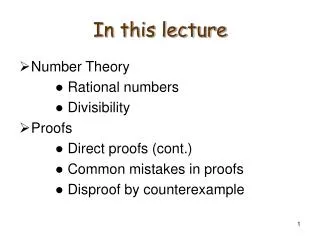
In this lecture • Number Theory ● Quotient and Remainder ● Floor and Ceiling • Proofs ● Direct proofs and Counterexamples (cont.) ● Division into cases
Quotient-Remainder Theorem • Theorem:For nZ anddZ+ ! q,rZsuch that n=d·q+r and 0≤r<d. • q is called quotient; r is called remainder. • Notation:q = n div d; r = n mod d. • Examples: 1) 53 = 8·6+5. Hence 53 div 8 = 6; 53 mod 8 = 5. 2)-29 = 7·(-5)+6.Hence -29 div 7 = -5; -29 mod 7 = 6.
Example of using div and mod • Last year Halloween was on Sunday. Q.: What day is Halloween this year? Solution: There are 365 days between 10/31/10 and 10/31/11. 365 mod 7 = 1. Thus, if 10/31/10 is Sunday then 10/31/11 is Monday.
Proof Technique: Division into Cases • Suppose at some stage of a proof ● we know that A1 or A2 or A3 or … or An is true; ● want to deduce a conclusion C. • Use division into cases: Show A1→C, A2→C, …, An→C. Conclude that C is true.
Division into Cases: Example • Proposition:If nZ s.t. neither of 2 or 3 divide n, (1) thenn2 mod 12 = 1. (2) • Proof: Suppose nZ s.t. neither of 2 or 3 divide n. By quotient-remainder theorem, exactly one of the following is true: a)n=6k, b)n=6k+1, c)n=6k+2, d)n=6k+3, e)n=6k+4, f)n=6k+5 for some integer k. (3) n can’t be 6k, 6k+2 or 6k+4 because in that case 2 | n (which contradicts (1) ). (4) n can’t be 6k+3 because in that case 3 | n (which contradicts (1) ). (5)
Division into Cases: Example(cont.) • Proof(cont.):Based on (3), (4) and (5), either n=6k+1 or n=6k+5. Let’s show (2) for each of these two cases. Case 1: Suppose n=6k+1. Then n2 = (6k+1)2=36k2+12k+1 (by basic algebra) = 12(3k2+k)+1 (6) Let p=3k2+k. Then p is an integer. n2 = 12p+1 . ( by substitution in (6) ) Hencen2 mod 12 = 1by quotient-remainder th-m. Case 2: Suppose n=6k+5. (exercise)■
Floor and Ceiling • Definition: For any real number x, ● the floor of x: = the unique integer n s.t.n ≤ x < n+1; ● the ceiling of x: = the unique integer n s.t.n-1 < x ≤ n. • Examples:
Properties of Floor and Ceiling • For xR andmZ , . • is false. Counterexample: For x=1.7, y=2.8, Note:If x,y>0 and the sum of their fractional parts is <1 then
Properties of Floor and Ceiling • Theorem: For nZ , • Proof: Case 1: Suppose n is odd. Then n=2k+1 for some integer k. (1)
Properties of Floor and Ceiling • Proof (cont.): By substitution from (1), (2) because kZ and k ≤ k+1/2 < k+1. On the other hand, n=2k+1 → k=(n-1)/2. (by basic algebra) (3) Based on (2) and (3), Case 2: n is even (left as exercise). ■