Download
1 / 15
150 likes | 260 Vues
This document discusses critical aspects of trauma hemorrhage management, emphasizing the importance of rapid recognition and intervention to reduce mortality rates. Approximately 30-40% of early trauma deaths are attributed to hemorrhage, often occurring within the first four hours. The report outlines specific imaging signs of active bleeding and treatment methodologies, including damage control surgery and IR procedures. Early and effective intervention is crucial, highlighting the stark contrast in 72-hour mortality rates between patients receiving timely treatment versus those experiencing delays. ###

E N D
“I’m stuck in x-ray, fiddling around with a bleeder” “X-ray is not a safe environment for anaesthetics” “Have you done something?, the blood pressure has recovered” Recent mixed reviews
Background • 30-40% of early trauma deaths due to haemorrhage • 62% of all in hospital deaths within 4hrs • Haemorrhage either primary cause or contributing factor • “Majority of preventable deaths after injury occur from unrecognised and hence untreated haemorrhage, particularly within the abdominal cavity making it perhaps the single most important reversible cause of death in the trauma population”. Trauma: Who cares? A report of the National Confidential Enquiry into Patient Outcome and Death (2007)
Haemorrhage control concepts • Aims • Stop the bleeding (with surgery or IR) • Restore circulating volume • Damage control surgery • Staged approach in exsanguinating patients • Permissive hypotension • Maintenance of vital functions without increasing risk of further haemorrhage
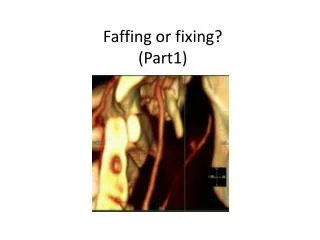
Imaging signs of active bleeding • Contrast extravasation
IR treatment of active bleeding • Contrast extravasation No treatment Patient died in A&E
Treatments • False aneurysm False aneurysm Filled with glue
Treatments • Missing vessel Selective angiogram Vessel coiled
Treatments • 4 Big hole in vessel • Gelfoam slurry • No improvement • Vessel glued
Shock • Inadequate tissue perfusion • Haemorrhage leading cause • Coagulopathy • Acidosis • Hypothermia • All independently predict poor outcome
Treatment • Recognition • Stop bleeding • Restore circulatory volume • Improved oxygenation • Better outcome ? • Prompt intervention, not last resort
Outcomes • 72 hour mortality • Patients who had surgery 22.7% (25/110) • No surgery 13.7% (92/670). • Patients who had timely intervention to control bleeding the 72 hour mortality was • 23.8% (15/63) • 33.3% (8/24) where intervention was considered delayed. Trauma: Who cares? A report of the National Confidential Enquiry into Patient Outcome and Death (2007)

















![[2018] IIA-CIA-Part1 Dumps PDF - 100% Pass Guarantee](https://cdn4.slideserve.com/7967909/slide1-dt.jpg)