Understanding Generators: Renewable vs Non-Renewable Energy Sources and Energy Density
240 likes | 363 Vues
This lesson explores the workings of generators through electromagnetic induction, where a changing magnetic field induces electric current. We differentiate between renewable and non-renewable energy sources, noting that non-renewable sources like fossil fuels and nuclear energy are finite, while renewable sources like solar, wind, and biomass are linked to the sun. Energy density is examined, detailing how much energy can be obtained from a unit mass of fuel, with comparisons of various fuels, including coal, wood, gasoline, and uranium.


Understanding Generators: Renewable vs Non-Renewable Energy Sources and Energy Density
E N D
Presentation Transcript
Topic 8 – Lesson 2 • Workings of a generator • Energy sources • Renewable and non-renewable • Energy density
Electromagnetic induction If a magnet is moved inside a coil an electric current is induced (produced)
Electromagnetic induction A electric current is induced because the magnetic field around the coil is changing.
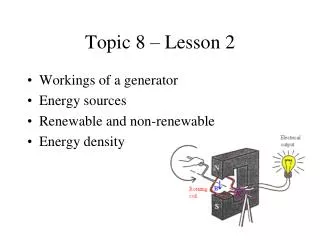
Generator/dynamo A generator works in this way by rotating a coil in a magnetic field (or rotating a magnet in a coil)
Non-renewable • Finite (being depleted – will run out) • In general from a form of potential energy released by human action
Renewable • Mostly directly or indirectly linked with the sun • The exception is tidal energy
Energy Density • The energy that can be obtained from a unit mass of the fuel • J.kg-1 • If the fuel is burnt the energy density is simply the heat of combustion
Energy density • Coal - 30 MJ.kg-1 • Wood - 16 MJ.kg-1 • Gasoline – 47 MJ.kg-1 • Uranium – 7 x 10⁴ GJ.kg-1 (70000000 MJ.kg-1)
Hydroelectric energy density? • Imagine 1 kg falling 100m. • Energy loss = mgh = 1x10x100 = 103 J • If all of this is turned into electrical energy it gives an “energy density” of the “fuel” of 103 J.kg-1