Gravitation
100 likes | 203 Vues
Explore the fundamental principles of gravitation, including the gravitational force between objects, how mass and distance affect this force, and the concept of gravitational field strength. Learn to calculate gravitational acceleration on Earth and the Moon, as well as the gravitational potential energy involved when moving masses in a gravitational field. Understand escape velocity and how it relates to gravitational potential energy and kinetic energy. This guide presents essential formulas and calculations that underline the behavior of gravitational forces in physics.


Gravitation
E N D
Presentation Transcript
Gravitation AHL 8.2
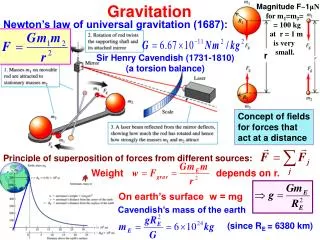
F = GMm/r2 • All objects exert a force on each other • If either mass increases the force increases • Double the mass doubles the force • If the distance decreases the force increases • Half the distance gives 4 times the force
Gravitational field strength • Gravitational field strength is the force per unit mass • g = F/m • On Earth g = 10Nkg-1 • How much force wil the Earth’s gravity exert on 3 kg • 30N • The force on 10kg on the moon is 17N. Calculate g on the moon • g = F/m = 1.7 Nkg-1
g = GM/r2 • F = GMm/r2 • g = F/m = GM/r2 • Mass of Earth = 6x1024kg • Radius of Earth = 6.4 x10⁶m • Calculate g on Earth • g = GM/r2 • = 6.67x10-11 x 6x1024/ (6.4 x 10⁶)2 • = 9.8 Nkg-1
Star planet g is a vector g from star g from planet Total g = Vector sum
F F S N N S Gravitational PE • These magnets have no energy when they are separated • You do work when you push them together • When they are close together potential energy is stored • Let them go and the energy is released PE
S N F F S N Gravitational PE • The magnets have zero energy when they are apart. • They slide together and have less energy (negative) • A force must do work to pull them back to zero • When objects attract each other they have negative potential energy - PE
Amount of work needed to remove object Zero energy Gravitational Potential • Gravitational potential is always negative • The potential at a point is the amount of energy needed to move 1 kg from infinity to that point • V = -GM/r Back to zero energy Attracted by gravity Negative PE planet A distant object has zero PE
Amount of work needed to remove 2 kg Amount of work needed to remove 1kg Zero energy Gravitational Potential Energy V = -GMm/r The potential at a point is the energy needed to move 1 kg from infinity to that point The potential energy of an object is the energy needed to move the object from infinity to that point PE = mV = -GMm/r Back to zero energy Attracted by gravity Negative PE 1 kg 2kg planet
planet Escape velocity • How fast must an object go so that it doesn’t come back? • It must have enough KE to overcome the negative PE (-GMm/r) and get to zero energy • 1/2mv2 = GMm/r • V2 = 2GM/r • V = (2GM/r) Calculate the escape velocity of Earth r= 6.4 x10⁶m m =6 x 1024 kg v = (2GM/r) = (2 x 6.67 x 10-11 x 6 x1024 / 6.4 x10⁶) = 11 000 ms-1 = 11kms-1