Populations Chapter 5
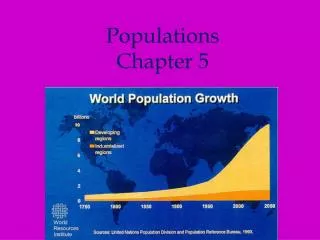
This chapter explores the key characteristics of populations, focusing on their growth patterns—exponential and logistic. It elucidates the concepts of geographic distribution, density, and growth rates, highlighting factors like immigration and emigration. The chapter illustrates the exponential growth model, showing how populations can grow rapidly under ideal conditions, portrayed by a "J" curve. In contrast, it discusses logistic growth, where limiting factors lead to stabilization at carrying capacity, reflected in an "S" curve. Understanding these dynamics is essential for studying ecological balance and population management.

Populations Chapter 5
E N D
Presentation Transcript
PopulationsChapter 5 Wakefield 2010-2011
How Populations Grow • Characteristics of a population: • Geographic Distribution / Range • The area inhabited by the population • Density • The number of individuals per unit area • Growth rate • Rate at which a population grows • # of births • # of deaths • Immigration / Emigration • Population Age • Shows the # of individuals in various age ranges
How Populations Grow • Characteristics of a population: Immigration – the movement of individuals into an area – causes population growth Emigration – the movement of individuals out of an area – causes population to decline
How Populations Grow • Exponential growth – occurs when the individuals in a population reproduce at a constant rate – occurs under ideal conditions - shown as a “J” curve • Logistic growth – occurs as resources become less available; the growth slows or stops – shown as an “S” curve
Logistic growth Exponential growth S-shaped curve Limits on growth J-shaped curve No limits on growth Unlimited resources Constant growth rate Falling growth rate Concept Map Exponential vs. Logistic Growth Section 5-1 Population Growth can be characterized by represented by characterized by represented by which cause a
Figure5-4LogisticGrowthofYeastPopulation Carrying Capacity – represents the total number of individuals an environment can support at one time Section 5-1 Carrying capacity Number of Yeast Cells Time (hours)
Limits to Growth • Limiting Factor – a factor that causes population growth to decrease • Density dependent limiting factors – • Competition • Predation / Predator – Prey Relationships • Parasitism • Disease • Density independent limiting factors – • Unusual weather, natural disasters, seasonal cycles, flooding, human activities, deforestation
A Density-Dependent Limiting Factor Section 5-2 Growth of Aphids Exponential growth Peak population size Rapid decline Steady population size Steady population size
Figure 5-7 Wolf and Moose Populations on Isle Royale Section 5-2 60 2400 50 2000 40 1600 1200 30 20 800 10 400 0 0 1955 1960 1965 1970 1975 1980 1985 1990 1995 Moose Wolves