General Motors: A Comprehensive History and Future Outlook
Explore the rich history of General Motors from its founding in 1908 to its government bailout, bankruptcy, and subsequent resurgence. Learn about the company's strengths, weaknesses, opportunities, and threats, as well as its geographic and economic factors. Discover how GM navigated through financial challenges, adapted to industry trends, and positioned itself for future success.

General Motors: A Comprehensive History and Future Outlook
E N D
Presentation Transcript
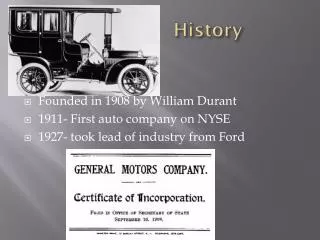
History • Founded in 1908 by William Durant • 1911- First auto company on NYSE • 1927- took lead of industry from Ford
History • 1970’s-80’s Japanese gain market share • GM tried to match smaller car styles • 2000’s- Recalls and Strikes
History • 2008: 5,000 salary layoffs • 2009: Government Bailout • Ch. 11 Bankruptcy • Motors Liquidation Company • 2010: Rebirth, Restructure, • Largest IPO
History • Present Day: Daniel Akerson trying to get GM back on top. • Greener Cars • Repay debt to the government
Government Interaction • Federal Emissions Requirements • Catalytic Converter • Safety
Technological Advances • Plastic/Carbon Fiber Body • OnStar • Hybrid Cars • Hydrogen Powered cars
Industry Analysis • Barriers to Entry • High • Intensity of Rivalry • Extremely High • Bargaining Power of Suppliers • Low • Bargaining Power of Buyers • Low • Substitutes • Low
Strengths • High Liquidity • Allows them to be more flexible in the future • Strong Global Presence • New found focus on individual brands • Increased product quality
Weaknesses • Customer Loyalty • Stigma from the bailout • “Holes in the line up” • Declining US Market Share • United Auto Workers
Opportunities • Emerging Markets • South America • China • Alternative Fuel Technologies
Threats • Volatile Economy • Raw Material Prices • Oil Prices
Geographic and Economic Factors • Headquarters in Detroit, Michigan • Became global in the 1920s • Now manufacture vehicles in 31 countries
Four Geographically-Based Segments • GM North America • GM Europe • GM South America • GM International Operations
Automobile Industry Factors and Business Cycle • Retail sales fluctuate according to season • Production varies each month • Changeovers occur often throughout the year • New market entries, vehicle models • Business cycle depends on general economic conditions and consumer spending
The Economy • The recession had a negative effect on GM’s United States Market • It also affected factors that determine consumers’ buying decisions • E.g. Price, quality, available options, style, safety, reliability, fuel economy, and functionality
Financial Help From Congress • G.M. Files for Bankruptcy • Dramatic Turnaround • Profitability Helped by Tax Breaks Carried Over Through Bankruptcy
A Slow Recovery • G.M. Announces Still Losing Money in November 2009 • 2010 Turnaround -Rebuilding Operations -Increased Sales - full-year profit was equal to $2.89 a share
Focus Factors • Competitive Cost Structure • Cleaner Balance Sheet • Stronger Liquidity
2011 Earnings: 1st Quarter • G.M. made $3.2 Billion in the 1st Quarter -5th Consecutive Profitable Quarter • Sales
Competitors and Their Reactions to Economic Conditions • In 2005 the auto industry rides a new trend of “Employee Prices for Everyone”. • 2005 is a tough year for both companies. • “Way Forward” • GM looks for government help • GM emerges from bankrupcy • Ford rebuilds workforce
GM in the Future • Now -Akerson Keeping the Ship Upright • 5 Years -New CEO -Hydrogen Cars -Emerging Markets • 20+ Years -Hydrogen Gas Stations -Staying Within Their Limits