Riverbank Protection via High-Strength R/C Structures in Romania
170 likes | 333 Vues
In Romania, riverbank erosion and floods are perennial issues. This research project proposes a solution using high-strength R/C structures to protect riverbanks efficiently. By utilizing lightweight structures with heavy concrete elements, the aim is to offer a technically feasible and technologically efficient approach. The project involves addressing various challenges such as wave actions, wind actions, earthquakes, and uncertainties regarding structural behavior in marine and riverbank environments. By leveraging high-strength R/C materials and innovative construction methods, this initiative seeks to provide a sustainable solution for riverbank protection. The research also delves into the history and mechanical parameters of high-strength concrete, highlighting its benefits and ways to enhance its properties for better structural performance. The proposed R/C solutions include shell elements for riverbank protection, retaining walls, and a floating erection technology.


Riverbank Protection via High-Strength R/C Structures in Romania
E N D
Presentation Transcript
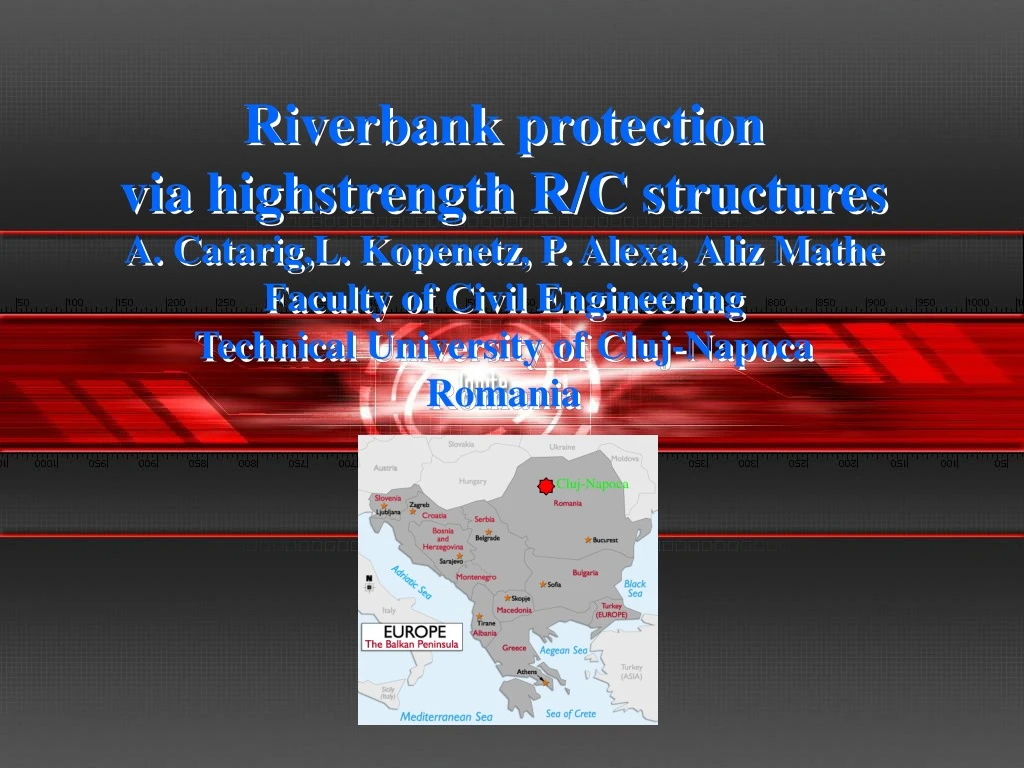
Riverbank protectionvia highstrength R/C structuresA. Catarig,L. Kopenetz, P. Alexa, Aliz MatheFaculty of Civil EngineeringTechnical University of Cluj-NapocaRomania Cluj-Napoca
CONTEXT OF CURRENT CONTRIBUTION - LIGHTWEIGHT STRUCTURES THROUGH HEAVY CONCRETE LIGHTWEIGHT STRUCTURES HIGH STRENGTH R/C • Though it looks a contradiction in terms, we all know that large • R/C light weight structures can be built using high strength • concrete. • The idea of using concrete for lightweight structures is neither • new nor unknown. RIVER BANK EROSION AND FLOODS PERENIAL PROBLEMS IN ROMANIA • Romania has experienced for a long time difficulties and never solved problems regarding mainly the protection of river banks and – in general – of shore protection. Every year somwhere a bank is either sliding or some area is flooded. Recently, a national program of river bank protection has started to be implemented. LOOKING FOR A TECHNICALLY FEASIBLE AND TECHNOLOGICALLY EFFICIENT SOLUTION VIA HIGH STRENGTH R/C • Our small research team (in lightweight structures) decided to participate in the first phase – that of proposing technical and technological solutions (on a contractual basis) to this program. This is the context the present contribution of our group has come to be a current research concern. • The research program includes, also, a well known (in Romania) contractor, mainly, in dam constructions. Together, we decided to propose a technically feasible and technologically efficient solution for bank protection using modulated highstrength R/C elements that make up large lightweight strcutures.
Loads • Wave actions • Wind actions • Earthquake • Geological tranformations of neightbouring enviroment
Uncertainties • Impossibility of a total control structural behaviour in marine and other bank environments • Limits of mechanical parameters of R/C sections in marine and bank environments • Lowest geometrical limits of R/C sections in marine and bank environments
Short history of R/C in marine structures • Marine containers of Pier Luigi NERVI-1943. Started with a 40 mm thickness wall. Ended up with 12 mm thickness. • Technological difficulties postponed further use until 1985- development of: • High strength R/C • Self compacted R/C technology • Fibre reinforced concrete
Some mechanical parameters of high strength concrete • Minimum strength in compression fck= 51.0 MPa • Current values of strength in compression fck= 60.0-150.0 MPa • Reported values in laboratory investigations over 150.0 MPa • Very dense material structures • High initial compression strength • Reduced thermal reological properties • High endogen shrinkage in its first stage cracks immediately after pouring • Reduced fire resistance
Improving some properties • Adding steel, carbon, polypropilene fibres higher ductility, higher fire resistance • Substituting usual aggregates with lightweight aggregates reduced shrinkage and cracks • Adding silica powder (ground glass) used in electro-filters in fero-silica industry. Specific surface of a silica granule is 2000.0 sqm/kg (versus 280.0 – 450.0 sqm/kg of the usual Portland cement) better cohesion, reduced thermal reological phenomena, higher elasticity module. • Also, silica powder reduced workability higher W/C ratio. • The W/C ratio has to be between 0.20 -0.40, therefore the use of plasticizers is vital. • Plasticizers: form-aldehides, polycondenced sulphonates, melanimes (dosage under 1 %)
Proposed high strength R/C solutionusing shell elements river
Proposed highstrength R/C solution • Legend 1- Foundation 2- Equalizing concrete layer 3- Ferrocement precast shell 4- Selfcompacting concrete 5- Hole for concrete 6- Hole for air extraction