Comprehensive Guide to Writing a Lab Report in MLA Format
This guide provides a detailed overview of how to compose a lab report following MLA format. Key aspects include using 10 or 12 pt. font in Times New Roman or Arial for the main text, structuring the report with an introduction, materials, procedure, data tables, graphs, and conclusion. Emphasize clarity and neatness while avoiding personal pronouns. Know how to formulate observations, state a hypothesis, outline the procedure, and effectively present data. Learn to construct a strong conclusion based on collected evidence, ensuring a logical connection between your findings and hypothesis.

Comprehensive Guide to Writing a Lab Report in MLA Format
E N D
Presentation Transcript
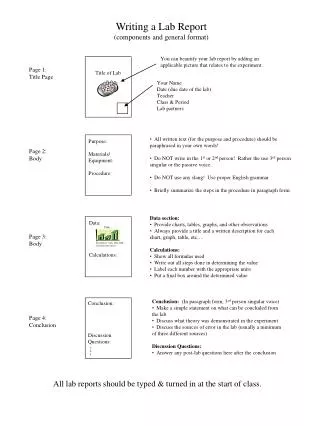
Format • Typed in MLA format • 10 or 12pt font • Times New Roman or Arial for main text • Titles can be in other fonts • Neat • AVOID pronouns (such as “I” and “we”)
Introduction • Observation(s) • Main Investigative Question • Hypothesis • “If … then … because …”
Materials • List or paragraph format • Include all materials used
Procedure • Paragraph format • Only include relevant procedural information • Ex. “Put on goggles” or “Click ‘OK’” is unnecessary • Include independent and dependent variables • Include at least 3 controls • Include at least 1 validity measure • Include what data is to be recorded and how it will be done
Data Tables & Graphs • Include properly formatted data table(s) • Include proper graph(s) • Graph must be complete • Title, axis labels, axis units, etc.
Conclusion • Paragraph format • Restate the purpose of the experiment • Restate the hypothesis • State your claim about the hypothesis • Is the hypothesis supported or not • AVOID words like “prove” or “correct” • Provide evidence for your claim • DoNOT list off all data • Do reference high/low data points and trends • Make a logical connection (reasoning) between hypothesis, claim, and evidence