Viruses
A virus is a minuscule particle that invades and often destroys host cells, causing various diseases, from the common cold to AIDS. While viruses contain proteins and nucleic acids, they do not exhibit characteristics of living organisms, such as metabolism or growth, requiring a host for survival. They can be classified by disease type, genetic material, or shape. Viruses reproduce by hijacking host cells through the lytic cycle, or they may remain dormant in the lysogenic cycle. Discover the fascinating and complex world of viruses, their classification, and lifecycle.

Viruses
E N D
Presentation Transcript
Viruses Pgs. 33 - 35
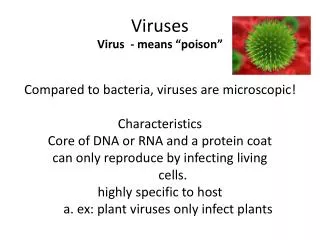
What is it? • A virus is a microscopic particle that invades a cell and often destroys it. • Many diseases are caused by viruses, including the common cold, the flu and acquired immune deficiency syndrome (AIDS) • They are so tiny 5 billion can fit in a drop of blood. • There are billions of different types of viruses.
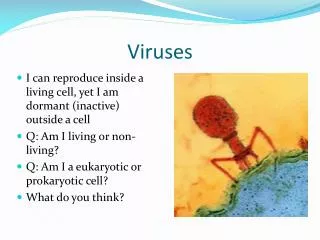
Are they Living? • Viruses contain protein and nucleic acids like living things. • However, they do not eat, grow, breathe, or perform other biologic functions. • They cannot live on their own, they require a host to exist. • They invade cells and make the cell produce viruses instead of new cells
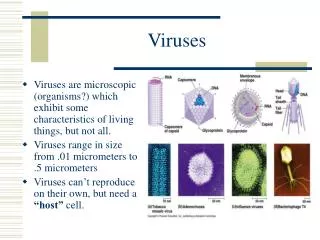
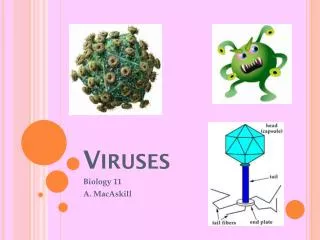
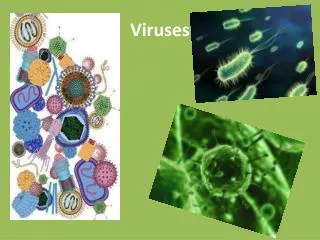
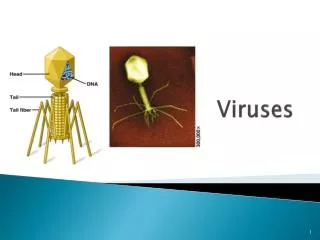
Classifying Viruses • Viruses can be grouped by the type of disease, life cycle, or genetic material they contain. • The shape can be used to classify them as well. • Examples are: • Crystals - polio • Spheres - Influenza • Cylinders – tobacco mosaic • Spacecraft – attack bacteria
Destructive Guest • The one function that viruses share with living thing is that they reproduce. • They infect living cells and turn them into virus factories in a cycle called the lytic cycle.
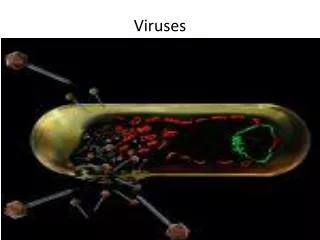
Lytic Cycle • Step 1 – the virus finds a host cell. • Step 2 – The virus enters the cell or in some cases, the virus’s genes are injected into the cell. • Step 3 – once the virus’s genes are inside, they take over the direction of the host cell, turning it into a virus factory. • Step 4 – The new viruses break out of the host cell ready to find a new host.
Clever Little Virus • Some viruses do not go into the lytic cycle. • They invade a host cell, but do not reproduce right away. • The host cell will reproduce with copies of the virus’s genes. • This is the lysogenic cycle. • The viruses can be inactive for long periods before they launch into the lyctic cycle.