Enhancing Software Development with Component-Based Architecture Principles
This text discusses the core principles of component-based software development, emphasizing the advantages of reusing existing components over building software from scratch. The focus is on leveraging off-the-shelf components across various programming languages, ensuring easy upgrades thanks to precompiled components. It also highlights key technologies such as Microsoft COM, CORBA, and OPC for real-time integration in industrial settings. Application examples include network-transparent communication and industry-specific controls, showcasing scenarios in refrigeration processes and PLC integration.

Enhancing Software Development with Component-Based Architecture Principles
E N D
Presentation Transcript
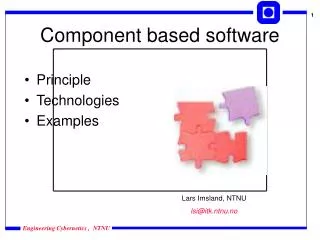
Principle Technologies Examples Component based software Lars Imsland, NTNU lsi@itk.ntnu.no
Reuse Pick the best components (“off-the shelf”-components) Use different languages Easy upgrade (precompiled components) Advantages
Microsoft COM (DCOM/COM+) CORBA A specification, not implementation (OMG) Platform independent Javabeans The component model for Java Technologies
A specification and implementation Microsoft specific Most used Network transparent (DCOM) Communication specified with interfaces Microsoft COM
OPC is a specification that sets a standard for integration of real-time devices, PLCs or DCSs with business- or plant- applications OPC is based on COM OPC is a set of COM interfaces OPC is network transparent OPC - what is it?
Data access (v2.0) Alarms and events Historical data access Batch Windows CE OPC specifications
Laboratory: Industrial plant: Controller Controller Specification, Criteria, Reference, Supervision Specification, Criteria, Reference, Supervision MMI MMI WEB Estimator WEB Estimator OPC Client Interface OPC Client Interface Communication network Communication network OPC Server Interface OPC Server Interface General simulator Simulation model Process Control System Industrial Plant
Refrigeration process Well known Suitable for different control strategies Suitable for modeling and identification Well instrumented (20 measurements, 4 controls) Physical Process
Physical Process II Motor M Compressor Expansion valve Condenser Evaporator
OPC Client Controller Supervisor OPC Data Server (NT) PLC software Local MMI PLC Web-browser somewhere on the internet Ethernet S7-400 Siemens WinCC Siemens APIS/SIP Prediktor AS “Home-made” components Netscape, Internet Explorer, etc. Communication architecture
Infrastructure • Physical Process • Refrigeration process • Instrumented • Controller • PLC • PC • Intranet • Supervision • PC • Intranet • Internet