Download
1 / 1
10 likes | 110 Vues
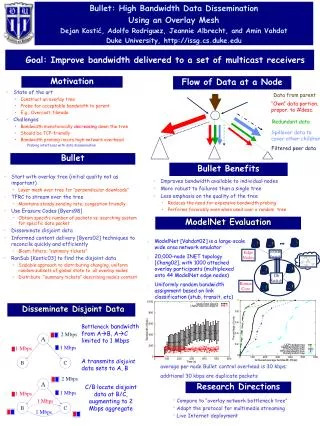
ModelNet is a sophisticated wide-area network emulator designed for performance evaluation. With a 20,000-node INET topology that accommodates 1,000 attached overlay participants, the system utilizes efficient bandwidth assignment based on link classification. The emulation framework prioritizes high-bandwidth data dissemination via an overlay mesh strategy, significantly improving multicast receiver performance. It integrates advanced techniques like TFRC, erasure codes, and Bloom filters to facilitate disjoint data distribution while minimizing network overhead. The approach offers robustness against failures and enhances overall bandwidth delivery.

E N D
ModelNet Evaluation • ModelNet [Vahdat02] is a large-scale wide area network emulator • 20,000-node INET topology [Chang02], with 1000 attached overlay participants (multiplexed onto 44 ModelNet edge nodes) • Uniformly random bandwidth assignment based on link classification (stub, transit, etc) EdgeNodes 100MbSwitch GbSwitch RouterCore average per node Bullet control overhead is 30 kbps; additional 30 kbps are duplicate packets Bullet: High Bandwidth Data Dissemination Using an Overlay MeshDejan Kostić, Adolfo Rodriguez, Jeannie Albrecht, and Amin VahdatDuke University, http://issg.cs.duke.edu Goal: Improve bandwidth delivered to a set of multicast receivers Motivation Flow of Data at a Node • State of the art • Construct an overlay tree • Probe for acceptable bandwidth to parent • E.g., Overcast, Narada • Challenges • Bandwidth monotonically decreasing down the tree • Should be TCP-friendly • Bandwidth probing incurs high network overhead • Probing interferes with data dissemination Data from parent “Own” data portion, propor. to #desc. Redundant data Spillover data to cover other children Filtered peer data Bullet Bullet Benefits • Start with overlay tree (initial quality not as important) • Layer mesh over tree for “perpendicular downloads” • TFRC to stream over the tree • Maintains steady sending rate; congestion friendly • Use Erasure Codes [Byers98] • Obtain specific number of packets vs. searching system for specific data packet • Disseminate disjoint data • Informed content delivery [Byers02] techniques to reconcile quickly and efficiently • Bloom filters, “summary tickets” • RanSub [Kostic03] to find the disjoint data • Scalable approach to distributing changing, uniform random subsets of global state to all overlay nodes • Distribute “summary tickets” describing node’s content • Improves bandwidth available to individual nodes • More robust to failures than a single tree • Less emphasis on the quality of the tree • Reduces the need for expensive bandwidth probing • Performs favorably even when used over a random tree Disseminate Disjoint Data Bottleneck bandwidth from AB, AC limited to 1 Mbps 2 Mbps A 1 Mbps 1 Mbps B C A transmits disjointdata sets to A, B 2 Mbps A Research Directions C/B locate disjoint data at B/C, augmenting to 2 Mbps aggregate 1 Mbps 1 Mbps 1 Mbps • Compare to “overlay network bottleneck tree” • Adapt the protocol for multimedia streaming • Live Internet deployment B C 1 Mbps