The jazz age
The jazz age. Ch. 10. Politics of the Jazz age. Warren G. Harding. “A return to normalcy” Many of his cabinet appointments were his friends The Ohio Gang


The jazz age
E N D
Presentation Transcript
The jazz age Ch. 10
Warren G. Harding • “A return to normalcy” • Many of his cabinet appointments were his friends • The Ohio Gang • Some members used their government positions to sell jobs, pardons, and immunity from prosecution. Before most of the scandals became public knowledge, Harding fell ill and died in 1923 • Teapot Dome • Albert B. Fall, secretly allowed private interests to lease lands containing U.S. Navy oil reserves at Teapot Dome, Wyoming. • He received bribes totaling over $300,000. The Teapot Dome scandal ended with Fall being the first cabinet officer in history to be sent to prison
Attorney General Harry Daugherty • refused to turn over files and bank records for a German-owned American company. • Bribe money ended up in a bank account controlled by Daugherty. • He refused to testify under oath, claiming immunity, or freedom from prosecution, on the grounds that he had confidential dealings with the president. • Calvin Coolidge demands Daugherty’s resignation
Calvin Coolidge • Focus on prosperity through business leadership with little government intervention. • Is elected again in 1924
Policies of Prosperity • Under secretary of treasury, Andrew Mellon, the federal debt was reduced by $7billion between 1921 & 1929 • Mellon applied the idea of supply-side economics (trickle-down) to reduce taxes • Lower taxes would allow businesses and consumers to spend and invest their extra money, resulting in economic growth • Under secretary of commerce, Herbert Hoover, attempted to balance government regulation with cooperative individualism • Manufacturers and distributers were asked to form their own trade associations and share information with the federal governments Bureau of Standards • Hoover believed this would reduce waste and costs and lead to economic stability
Trade & Arms Control • By the 1920’s the US had become an dominant economic power • Allies owed America billions in war debts • Many Americans favored isolationism rather than become involved in more international issues • This was hard to accomplish as America had become so powerful and interconnected in international affairs to stay isolated • Other countries believed that it was Americas responsibility to help with the war’s financial debt • The US argued that the Allies had gained new territories and reparations (huge cash payments) from Germany as punishment for starting the war
Americans begin enjoying a new standard of living • Increased wages and decreased work hours • Mass production leads to increased supply of goods with low production costs • The assembly line
American attitudes about debt shifted, as they became confident that they could pay back what they owed at a later time • Businesses begin hiring professional managers • This will expand the size of the middle class • Unions begin to lose influence • Most employers will promote an open shop
The Farm crisis • Farmers do not share the prosperity of the 1920’s • prices dropped dramatically while the cost to improve farmers’ technology increased • During the war, farmers are encourages to overproduce to support war effort overseas • After WWI, Europeans can no longer afford to buy American products after Congress raised tariffs
Nativism resurges • Racism & nativism increase in the 1920’s • ethnic prejudice • Sacco & Vanzetti • Immigrants accused murder, theft, & anarchy • Sentenced to death in 1927 • Eugenics • Used by nativists • False science • Belief that human inequalities are inherited, inferior people should not be allowed to breed • Ku Klux Klan • Wants to restrict immigration • Targeted not only blacks, nut also Catholics, Jews, immigrants and people with “un-American values” • Surge in membership in early 1920’s • will again lose popularity as the decade closes
Emergency Quota Act- 1921 • limiting immigration to 3 percent of the total number of people in any ethnic group already living in the United States. • This discriminated heavily against southern and eastern Europeans • National Origins Act- 1924 • made immigrant restriction a permanent policy • lowered the quotas to 2 percent of each national group living in the U.S. in 1890 • exempted immigrants from the Western Hemisphere from the quotas
Immigration acts reduced labor pool in the US • Mexican immigrants begin moving into the US between 1914 until the end of the 1920’s
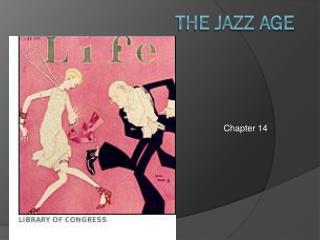
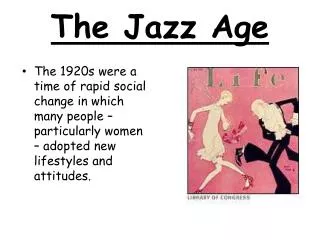
New Morality • challenged traditional ideas and glorified youth and personal freedom • Flappers • young, dramatic, stylish, and unconventional woman, exemplified the change in women’s behavior • Women begin making advances in fields of science, medicine, law, & literature
Fundamentalism • feared the new morality and worried about America’s social decline • rejected Darwin’s theory of evolution, which suggested that humans developed from lower forms of life over millions of years. Instead, • Fundamentalists believed in creationism—that God created the world as described in the Bible
Prohibition • 18th amended goes into effect in 1920 • Banned the manufacture, sale, transport, import, or export of alcohol • Believed it would stop unemployment, domestic violence, & poverty • Volstead Act • Makes the enforcement of prohibition the responsibility of the US Treasury
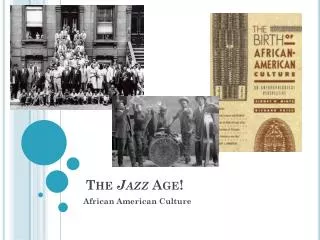
The Great Migration • In large northern cities, particularly New York City’s neighborhood of Harlem, African • Americans created environments that stimulated artistic development, racial pride, a sense of community, and political organization, • This will lead to a massive creative outpouring of African American arts.
Writers • Claude McKay • Langston Hughes • Zora Neale Hurston • Music • Louis Armstrong • Duke Ellington • Bessie Smith • Theatre • Paul Robeson • Josephine Baker • Artists • Aaron Douglas • Augusta Savage
The NAACP • Battled against segregation and discrimination. • The NAACP’s efforts led to the passage of anti-lynching legislation in the House of Representatives, but the Senate defeated the bill. • UNIA • promoted black pride and unity • encouraged education as the way for African Americans to gain economic and political power • Voicedthe need for separation and independence from whites