Difficulties with change
Change can evoke fear, uncertainty, and resistance, posing challenges for managers and organizations. The Chinese character for crisis encapsulates the dual nature of change, embodied in both threats and opportunities. To effectively manage change, it's essential to acknowledge the emotional landscape of employees, which can be divided into three categories: those eager to change, those willing to change, and those resistant to change. Understanding these dynamics allows consultants and managers to facilitate smoother transitions and create a culture more receptive to change.

Difficulties with change
E N D
Presentation Transcript
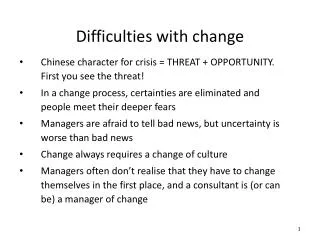
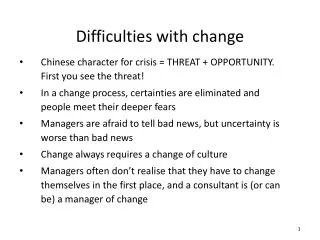
Difficulties with change • Chinese character for crisis = THREAT + OPPORTUNITY. First you see the threat! • In a change process, certainties are eliminated and people meet their deeper fears • Managers are afraid to tell bad news, but uncertainty is worse than bad news • Change always requires a change of culture • Managers often don’t realise that they have to change themselves in the first place, and a consultant is (or can be) a manager of change
Three types of people can be distinguished in a change process: • Eager to change • Willing to change • Resistant to change
People: Eager to change • Active, anticipating and self-adjusting attitude as an autonomous personal characteristic • Strive to assess one’s own performance and that of the department against the firm’s objectives • Strive to really introduce and implement change • Usually 20% of the population (general experience, not scientifically established) • Sometimes a small area of observation which may lead to sub optimisation
People: Willing to change • Willingness in principle of people to cooperate in change processes • Passive willingness, no resistance, willingness to cooperate if someone else takes the initiative • This willingness depends on the perception of the objectives of the change process; it is hence conditional • Usually 60% of a population • High chance of resistance if the change process is badly managed
People: Resistant to change • Totally inflexible; will not cooperate under any circumstance • Justification of this attitude by clichés • Number is dependent on past experiences but also autonomous • Usually 20% of a population • Sometimes strong and emotional resistance against the change, also when it is not in the person’s own advantage
Relevance for consultancy skills: • A consultant is an external change manager. • In that you will have clients in all three categories, recognizing and understanding their attitudes towards change can help smoothening the process. • If you perceive yourself to be resistant to change, consider not going into consultancy Reference: David Smith (2010), Exploring Innovation