

ISO 27000 Certificering
E N D
Presentation Transcript
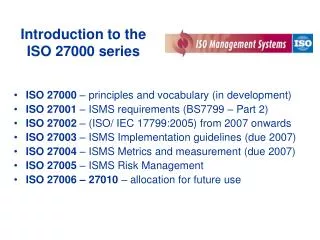
ISO 27000 Certification: A Complete Guide to ISO 27000 Certificering for Information Security Introduction to ISO 27000 Certificering In today’s digital world, protecting information has become a top priority for organizations of all sizes. ISO 27000 certificering refers to compliance with the ISO/IEC 27000 family of standards, which are designed to help organizations manage and protect sensitive information systematically. These standards provide a globally recognized framework for establishing, implementing, maintaining, and continually improving an Information Security Management System (ISMS). ISO 27000 certificering demonstrates an organization’s commitment to information security, risk management, and data protection. What Is ISO 27000 and Why It Matters The ISO 27000 series is a group of international standards developed by the International Organization for Standardization Electrotechnical Commission (IEC). The most well-known standard in this family is ISO/IEC 27001, which specifies the requirements for an ISMS and is the standard against which organizations are certified. ISO 27000 certificering matters because it helps organizations identify information security risks, apply appropriate controls, and ensure the confidentiality, integrity, and availability of information. In an era of cyber threats, data breaches, and strict data protection laws, ISO 27000 plays a critical role in building trust. (ISO) and the International Understanding the ISO 27000 Family of Standards The ISO 27000 family includes several interconnected standards, each serving a specific purpose. ISO/IEC 27000 provides an overview and terminology, while ISO/IEC 27001 defines certification requirements. ISO/IEC 27002 offers detailed guidance on information security controls, and other standards such as ISO/IEC 27005 focus on risk management. Together, these standards support organizations in building a robust and structured approach to information security. ISO 27000 certificering is often used as a general term to describe certification to ISO/IEC 27001 within this broader framework. Who Needs ISO 27000 Certificering ISO 27000 certificering is relevant to any organization that handles sensitive information, regardless of size or industry. IT companies, cloud service providers, financial institutions, healthcare organizations, government agencies, and e- commerce businesses commonly pursue certification. Even small and medium-sized enterprises benefit from ISO 27000 certificering when dealing with customer data, intellectual property, or confidential business information. Organizations seeking to
work with international clients or comply with contractual and regulatory requirements often find ISO 27000 certification essential. Key Requirements of ISO 27001 Certification ISO/IEC 27001 is built around a risk-based approach to information security. Organizations must define the scope of their ISMS, identify information security risks, and select appropriate controls to mitigate those risks. Key requirements include leadership commitment, information security policies, risk assessment and treatment, employee awareness and training, incident management, internal audits, and management reviews. Annex A of ISO 27001 provides a comprehensive list of security controls covering areas such as access control, cryptography, physical security, operations security, and supplier relationships. ISO 27000 Certification Process The ISO 27000 certificering process typically begins with a gap analysis to assess current information security practices Organizations then design and implement an ISMS, including policies, procedures, and technical controls. Once the system is in place, internal audits and management reviews are conducted to ensure readiness. Certification audits are carried out by an accredited certification body in two stages: Stage 1 reviews documentation and preparedness, while Stage 2 evaluates the effective implementation of the ISMS. Successful completion results in ISO 27001 certification, usually valid for three years with annual surveillance audits. against ISO 27001 requirements. Benefits of ISO 27000 Certificering ISO 27000 certificering offers numerous benefits beyond compliance. It strengthens information security, reduces the risk of data breaches, and improves incident response capabilities. Certification enhances customer confidence and demonstrates due diligence to stakeholders, partners, and regulators. It also helps organizations meet legal and regulatory requirements related to data protection and privacy. Internally, ISO 27000 certificering promotes a culture of security awareness, clear roles and responsibilities, and continuous improvement. Common Challenges in ISO 27000 Implementation Implementing ISO 27000 Certificering standards can be challenging, especially for organizations new to formal information security management. Common challenges include understanding complex requirements, allocating sufficient resources, managing organizational change, and maintaining comprehensive documentation. Risk assessment and control selection may also be difficult without experienced guidance. However, these challenges can be addressed through proper planning, training, and support from experienced consultants or certification partners.
Maintaining ISO 27000 Certification ISO 27000 certificering is not a one-time achievement but an ongoing commitment. Organizations must continually monitor risks, review controls, conduct internal audits, and improve their ISMS. Changes in technology, business processes, or regulatory requirements should be reflected in the ISMS. Annual surveillance audits by the certification body ensure continued compliance, while recertification audits are required every three years. Continuous improvement is a core principle of ISO 27000. ISO 27000 and Data Protection Regulations ISO 27000 certificering aligns well with global data protection regulations such as GDPR and other privacy laws. While ISO 27001 itself is not a legal requirement, it provides a strong framework for demonstrating compliance with data protection obligations. Organizations with ISO 27000 certification are often better prepared to manage personal data securely, respond accountability to regulators and customers. to incidents, and demonstrate Conclusion ISO 27000 certificering is a powerful tool for organizations seeking to protect information assets, manage risks, and build trust in a digital and interconnected world. By adopting the ISO 27000 family of standards and achieving ISO/IEC 27001 certification, organizations demonstrate a structured and internationally recognized approach to information security management. With growing cyber threats and increasing regulatory pressure, ISO 27000 certificering is no longer just a competitive advantage—it is a strategic necessity for sustainable and secure business operations.