Download
1 / 19
190 likes | 325 Vues
Anesthesia units are essential medical devices that administer anesthetics during surgical procedures. They provide a controlled mixture of gases and vapors vital for patient sedation, ensuring safety and comfort. These units monitor gas concentrations, maintain optimal environments by managing temperature and humidity, and include safety features to protect patients. Understanding the types of anesthesia, their administration methods, and the importance of precise calibration procedures is crucial for effective clinical practice and patient safety.

E N D
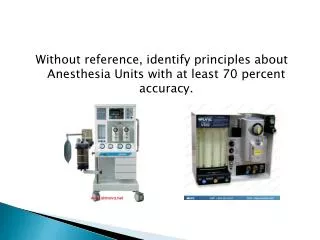
Without reference, identify principles about Anesthesia Units with at least 70 percent accuracy.
Anesthesia unit • Purpose of Anesthesia Units • Supplies a set mixture of gases and anesthetic vapors to the patient • Helps the clinician control patient breath rates, volumes, and pressures • Monitors gas concentrations from the anesthesia machine • Provides patient monitoring • Includes safety features to help protect the patient • Removes excess gases from the breathing system and out of the anesthetizing location
Anesthesia unit • Anesthetizing Locations • An area used to administer any flammable or nonflammable anesthetic agent such as the operating room, delivery room, emergency room and anesthetizing room • Requirements for a nonflammable anesthetizing area • Areas must be clearly labeled “RESTRICTED TO NONFLAMMABLE ANESTHETICS”
Anesthesia unit • Environments factors • Humidity must be maintained at a minimum of 35% • Ventilation requirements • Used to remove bacteria, anesthetic gases, and maintain proper humidity • A positive pressure is maintained within the anesthetizing area • Temperature • Decreases metabolic rate of the patient • Decreases blood loss • Decreases infection by minimizing bacteria growth
Anesthesia unit • Clinical Aspects of Anesthesia • Definitions • Anesthesia – the loss of the normal perception of pain • Anesthetic – a substance which produces anesthesia • Purpose of anesthesia – to remove the patient’s sensitivity to pain during surgical procedures
Anesthesia unit • Types of anesthesia • Local anesthesia • Applied only to the area of treatment • Patient remains conscious • General anesthesia • Applied to the entire body • Usually results in loss of consciousness • Administered one of two ways • Intravenous – the anesthetic is injected into the blood stream • Inhalation – the patient breathes a gas mixture containing the anesthetic agent
Anesthesia unit • Inhalation Anesthetics • Delivered by inhalation • May be gases or volatile liquids • All common anesthetics in use today are non-explosive and nonflammable • Minimum alveolar concentration level (MAC) • Concentration of any anesthetic agent in which 50% of the population will be anesthetized • The MAC level must be exceeded to ensure proper anesthesia
Anesthesia unit • Nitruous • It is colorless and odorless • Nitrous oxide is a gas at ambient temperature and pressure • Kept as a liquid under pressure • Does not provide significant muscle relaxation • MAC = 105% • Frequently used in combination with the more potent volatile agents
Anesthesia unit • Halogenated anesthetic agents • Causes rapid, shallow breathing • Relaxes skeletal muscles • Halothane • Detrimental effect on rubber goods and some metals • MAC = 0.77% • Isoflurane • Several side effects and is not popular • MAC = 1.77%
Anesthesia unit • Enflurane • Few side effects • MAC = 1.3% • Deslurane • Will not evaporate at room temperature • Requires a special heated vaporizer • Low solubility in blood and body tissues causes a very rapid wash-in and wash-out • MAC = 7.25% • Aevoflurane • Low solubility in blood and body tissues • MAC = 1.7%
Anesthesia unit • Stages of General Anesthesia • Induction – start of administration of the anesthesia agents (during induction it is very important to remain as calm as possible) • Excitement – the patient is delirious and physiologically unstable • Surgical Plane – the patient is insensible to pain. Breathing is steady and automatic • Danger – the patient is in danger of cardiopulmonary arrest
General Calibration Procedures for an Anesthesia unit • Guidelines set by the manufacturer must be strictly followed • Recommendations before attempting maintenance of this type of equipment • All test equipment and ventilators are not the same • Ventilator Operation is Usually Unsupervised • The calibrations are extremely critical to the support of the patient's health and/or life
General Calibration Procedures for an Anesthesia unit • Anesthesia Unit Operation is Usually Supervised • The calibrations are extremely critical to the support of the patients health and/or life • Tolerances • Are not as narrow as the ventilator due to the constant supervision of the patient • Still very real because of the drugs that are used • A unit’s reaction to the changes in the patient’s condition • Can cause under or over anesthetic dosage • Can lead to damage or death
General Calibration Procedures for an Anesthesia unit • Tolerances • Are narrower than most other devices in the hospital (ex. +/- 1% instead of +/-3%) • A units reaction to the changes in the patient's condition • Can cause under or over ventilation • Can lead to injury or death
General Calibration Procedures for an Anesthesia unit • Test Equipment • Calibrations are only as accurate as the calibration of the test equipment • Calibration Items • Pressure delivery • Pressure sensing • Peak • Mean • Peep
General Calibration Procedures for an Anesthesia unit • Overpressure • Volume delivered • Volume sensing • Breath rate • Oxygen blending • Assist sensitivity • Safety devices • Alarm limits
General Calibration Procedures for an Anesthesia unit • Anesthesia unit special items of concern • Safety devices • Proportioning system • Monitors the nitrous oxide flow to the oxygen flow to maintain <3:1 ratio • Designed to prevent oxygen concentration from falling below 25% • The kick-in point will • limit nitrous oxide flow from increasing if nitrous oxide is increased above 3:1 • increase oxygen flow if nitrous oxide is increased above 3:1 • Below 25% oxygen is considered hypoxic • decrease nitrous oxide flow if oxygen is decreased above 3:1
General Calibration Procedures for an Anesthesia unit • Secondary gas shutoff • Monitors the oxygen source pressure • Controls nitrous oxide and air flows (secondary gases) • Will either • Decrease flow of secondary gases in proportion to oxygen pressure • Shutoff flow instantly at a preset pressure • Either way the secondary gases will be completely cut-off before oxygen is depleted • Vaporizerinterlocks • Used on multiple vaporizer systems • Prevents more than one vaporizer from being turned on at a time
General Calibration Procedures for an Anesthesia unit • Alarm limits • Common/fresh gas concentrations • Ensure minimum oxygen content cannot be adjusted to hypoxic levels • Vaporizer • Calibration verification can only be performed • Use a Rankin gas analyzer • If verification falls outside of limits then vaporizer will be sent to manufacturer for repair or replacement