Mastering Equations: Solving Variable Equations with the Distributive Property
This resource is designed to help students understand and solve equations with variables on both sides. Learn how to use the distributive property effectively while solving various problems, such as finding supplements and complements of angles and consecutive integers. The guide features step-by-step examples, special cases, and practice problems to reinforce each concept, ensuring a comprehensive understanding of algebraic principles. Great for math labs and homework support!

Mastering Equations: Solving Variable Equations with the Distributive Property
E N D
Presentation Transcript
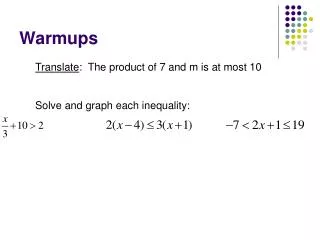
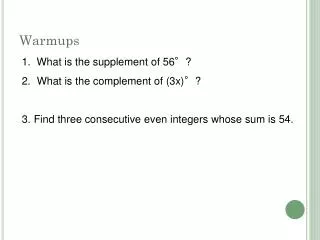
Warmups • 1. What is the supplement of 56°? • What is the complement of (3x)°? • Find three consecutive even integers whose sum is 54.
3-5 SOLVING EQUATIONS WITH THE VARIABLE ON BOTH SIDES Objective: To solve equations with the variable on both sides, and to use the distributive property to solve equations.
EXAMPLE 1 3x + 2 = 2x – 1 -2x -2x x + 2 = -1 - 2 - 2 x = -3 Check! 3(-3) + 2 = 2(-3) – 1 -9 + 2 = -6 – 1 -7 = -7 If variables are on different sides, you can NOT combine them! Must add/subtract to the other side. Always move the smaller coefficient.
Example 2 5x + 2 = 5 – x + x + x 6x + 2 = 5 - 2 - 2 6x = 3 6 6 x = 1/2 • Check! 5(1/2) + 2 = 5 – 1/2 2.5 + 2 = 5 – 0.5 4.5 = 4.5
TOO with a partner 1) 4x + 6 = 2x – 8 Answers: 1) x = -7 2) 7 – 3x = 10 – 4x 2) x = 3
Special Cases 7 – 3x = x – 8 – 4x 7 – 3x = -8 – 3x + 3x + 3x 7 = -8 False! Answer: No Solution -6n + 15 = 15 – 6n + 6n + 6n 15 = 15 True! Answer: All Numbers
Distributive Property Example 1 3(x + 2) = 18 3x + 6 = 18 - 6 - 6 3x = 12 3 3 x = 4 Check! 3(4 + 2) = 18 PEMDAS! 3(6) = 18 18 = 18
Examples 2) 4(x – 3) = 24 Answers: 2) x = 9 3) -2(5 + x) = 3 3) x = -13/2
TOO with a partner 4 – (x + 3) = 10 2x + 3(2 – x) = 10 4 – 3(x + 7) = 30 Answers: x = -9 x = -4 x = -47/3
EXAMPLE 4 2(x – 3) + 5 = 3(x – 1) 2x – 6 + 5 = 3x – 3 2x – 1 = 3x – 3 - 2x -2x -1 = x – 3 +3 + 3 2 = x x = 2 Steps Distribute Combine Like Terms Move Variables Add/Subtract Multiply/Divide Final Answer: x = #
Too For Homework • 2 + 6x – 3 = 8x + 4 – 2x • -10x + 5 + 2x = 6 – 4x – 1 • 12x + 5 = 10 + 14x – 5 – 2x Two are special cases One is normal Steps • Combine Like Terms • Move Variables • Add/Subtract • Multiply/Divide
Homework • Worksheet #23
Math Lab Warmups • The sum of three consecutive integers is 54. Find the three numbers. 2. The sum of 2 consecutive even integers is 114. Find the two numbers. 3. The sum of four consecutive even integers is 228. Find the four numbers.
Agenda • Finish Bingo • Homework Time