Transformative Experience: PIRE Undergraduate Program in Australia
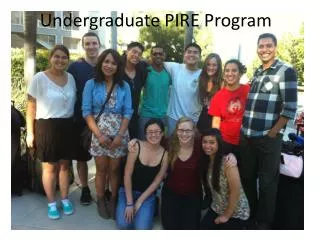
The PIRE Undergraduate Program took 12 students from UCI, UCLA, and UCSD to Australia for an immersive study of urban water management and sustainability. Accompanied by faculty and staff, participants engaged in lectures, field trips, and practical sampling of various wetland sites in Melbourne. The program fostered collaboration, introduced advanced data analysis techniques, and culminated in a mini-conference. Despite challenges of burnout and sustainability, it provided invaluable insights into global water issues and urban ecology.

Transformative Experience: PIRE Undergraduate Program in Australia
E N D
Presentation Transcript
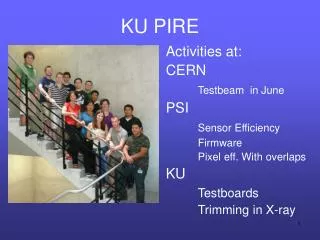
US participants traveling to Australia • 12 undergrads from UCI, UCLA, UCSD • +/- 1 UCI grad student (Laura Weiden) • 4 UCI faculty members (Sunny Jiang, Stanley Grant, Jean-Daniel Saphores, David Feldman) • 2 post-docs (Andrew Mehring from UCSD, Megan Rippy from UCI) • 1 HSSoE staff (Nicole Patterson—chaperone)
Lecturers on the US Side • 6 UCI faculty (P. Bowler, S. Grant, JD Saphores, D. Feldman, J. Brouwer, D. Rosso) • 3 External PIRE Affiliates (K. Schiff, A. Sengupta, R. Boon) • 4 UCI/UCSD post-docs (ZengchaoHao, Megan Rippy, Brandon Winfrey, Andrew Mehring) • 1 UCI Professional Staff (R. Demerjian)
Australian participants • 2 faculty fromUoM(A. Hamilton, M. Aurora) • 5 faculty from Monash (A Deletic, R. Brown, J. Lindsay, P. Raschky, L. Frost) • 6 post-docs/graduate students from Monash (G. Chandrasena, Y Li, K. Zhang, E. Payne, W. Feng, H. Fowdar) • 1 graduate student from UoM (A. Mccluskey)
Key Support Staff • Leyla Riley (UCI, HSSoE)-- logistics • Nicole Patterson (UCI, HSSoE) -- chaperone • Lorrie Aguilar (UCI, CEE) – logistics • James Beam (UCI, CEE) -- logistics • Michelle Mackay (UoM, School of Engineering) -- logistics
Week 1: UCI Urban Water Bootcamp • Introduction: logistics and preparation • Lectures: climate change, resource economics, water governance, wastewater treatment and reuse, stormwater capture and reuse • Field trips: • LA County Sanitation District’s Wastewater Reclamation Plant; • Orange County Groundwater Replenishment System; • UCI’s stormwater drainage system; • San Joaquin stormwater treatment wetlands
Week 2 and 3: Field sampling in Melbourne • Lectures: Melbourne’s water supply, indicator bacteria/viruses, wetland plants/animals, measuring physical parameters • Field trip: world’s largest wastewater stabilization pond • Field sampling: Royal Park Treatment Wetland, Hampton Park Treatment Wetland, Wikes Reserve Biofilter, Lynbrook Estates Biofilter and Constructed Wetland, Edithvale Natural Wetland, Hereford Biofilter • Monash Mini-conference: Biofilters for stormwater management (Day 1); the social science of urban water management (Day 2)
Undergraduate Field Program • 6 field sites in six days • At each site measure/quantify: • Dissolved Oxygen, pH, conductivity, temperature • Fecal Indicator Bacteria (E. coli and Enterococcus) by MF (EPA 1600 and 1603) • Human pathogens by QPCR • Chlorophyll, TSS, PAR, nutrients (phosphate, sulphate, and nitrogen species) • Invertebrate and plant communities
Site #1: Royal Park Constructed Treatment Wetland (B) (July 3, 2013) I5 M5 I4 M3 M4 M2 I3 O5 M1 O4 I2 O3 O2 O1 I1
Site #2: Hampton Park Treatment Wetland (July 4, 2013) O MD1 MD2 MD3 MD4 MD5 A1 A A3 B3 M8 M7 M6 B1 M5 M4 M3 M2 B M1
Site #3: Wikes Reserve Biofilter (The Basin, Victoria) (July 5, 2013) Outlet Sump T Outlet Tank O A1 B1 C1 A2 B2 Biofilter C2 I3 Centrifugal Trash Collector A3 B3 C3 I2 I1 Sedimentation Basin
Site #4: Lynbrook Estates Biofilter (A) and Treatment Wetland (B) (July 8, 2013) I P1 P5 P2 P6 P3 P4 P7 B1 B2 B3 B4 B5 L
Site #5: Edithvale Natural Wetland (July 9, 2013) P1-4 P2-4 P2-2 P1-3 P1-2 21 21 P2-3 P1-1 P2-1 P1-7 P1 P1-5 P1-6 P3-3 21 P3-2 21 P3-1 21
Week 4,5,6: Data analysis, posters, presentations, and videos • Lectures: QPCR, Basic statistics, advanced statistical tools (PCA, GLM, MLR, bootstrap methods), science communication, wetland plants, wetland animals • Field trip: Tour of SIO, collections visit, microscope observations, tour of Birch Aquarium • Data Analysis, Posters, Presentations, Videos: 4 teams • UPP Down Under Symposium
My observations: • Too much programming—everyone experienced serious burn out (staff, students, post-docs, faculty worked 24/7 in Australia) • Field work diffuse and not hypothesis driven (our initial foray into Melbourne LID features) • Not sustainable—some components would be difficult to repeat every year (e.g., Monash mini-conference) • Experience was not parlayed into K-12 modules—one of the few failures of FY1