When to Outsource: A Strategic Guide for IT and e-Business Management
In the ever-evolving landscape of IT and e-business, outsourcing has become a vital strategy for organizations. This guide explores the definition of outsourcing, its benefits including economies of scale and access to superior expertise, and the associated costs and risks such as loss of control and lack of innovation. Key recommendations include assessing core competencies, seeking trustworthy suppliers, and initiating with non-critical functions. By understanding the intricacies of outsourcing, businesses can make informed decisions to enhance their operational efficiency.

When to Outsource: A Strategic Guide for IT and e-Business Management
E N D
Presentation Transcript
Managing IT and e-Business - 2001 When to outsource? Pam Conley Greg Jerome Mathew Joseph Stellan Ohrn Enio Pagani Arnon Sela
Agenda • Definition and terms • Benefits • Costs • Risks • Recommendations • Source of information EMBA 2001, 0153
Definition Outsourcing is when a buyer transfers an ownership of process to a supplier EMBA 2001, 0153
Terms • Contracting – operation without ownership • BPO - business process outsourcing • ASP – application service provider • BSP – business service provider EMBA 2001, 0153
Benefits • Economy of scale • Management - competencies focus • Flexible resources • Superior worldwide expertise • Time to market and reduced cycle time EMBA 2001, 0153
Costs • Switching costs • Abdication of control • Lack of customization • Lack of technology innovation • Loss of differentiation EMBA 2001, 0153
Risks • Shirking • Poaching • Opportunistic re-pricing or holdup EMBA 2001, 0153
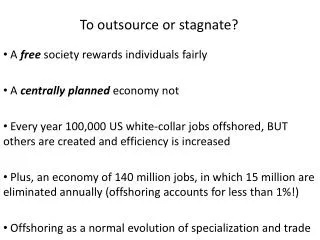
Recommendations Outsourcing of a function is desired when • It is a non-core competent of the buyer, • There is a supplier that can economically service that function, and • The supplier is trustworthy for delivering in a satisfactory manner. EMBA 2001, 0153
Recommendations (cont.) • Shop around • Start gradually with non-critical function • Short term contract • Clear and manageable scope • “Don’t expect what you don’t inspect” EMBA 2001, 0153
Recommendations (cont.) • Gain-sharing style • Mutual executive supervision • Cross functional teams • Best of breed EMBA 2001, 0153
Source of information • http://www.cio.com/forums/outsourcing • http://www.itworld.com • http://www.outsourcing-center.com • http://www.gartnergroup.com • http://www.computerworld.com • http://www.outsourcing.com EMBA 2001, 0153
Managing IT and e-Business - 2001 When to outsource? The End