Download
1 / 9
90 likes | 206 Vues
This document provides insights into the concepts of Electro-Magnetic Energy (EME) and Radio Frequency Radiation (RFR) as regulated by the FCC, OSHA, and other entities. It discusses the implications of RFR contact currents, the potential for burns on the human body, and establishes the Maximum Permissible Exposure (MPE) standards for non-ionizing radiation. Key terms and acronyms are clarified, outlining the responsibilities of organizations like Health Canada and Industry Canada in managing health and safety regarding electromagnetic radiation exposure in various frequencies.

E N D
CONFIDENTIAL R.S.I. CORPORATION From: RSI Rooftop Tape
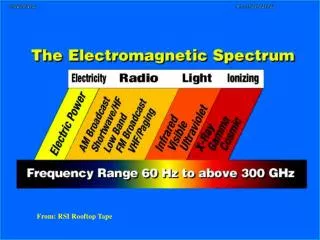
Cosmic Gamma X-Ray IONIZING RADIATION Ultra Violet Visible Light Infrared Microwave VHF/ Paging FM Broadcast Radio Low Band Short Wave/HF AM Broadcast 1 MHz Electricity 60Hz 1Hz
TERMS • EME (Electro-Magnetic Energy) • RF EME is also referred to as RF Radiation, EMR (Electro-Magnetic Radiation), and EMF (Electro-Magnetic Fields) • EME can Induce RFR contact current, which can lead to burns on the human body
TERMS • RFR:radio frequency radiation used by the radio people and includes E and M radiation. Also called just RF: or Radio Frequency • MPE: Maximum Permissible Exposure (the Law, rule or standard). • Radiation is a form of energy
Terms that are part of MPE Non-Ionizing Radiation Radio Frequency Radiation (RFR) RF Radiation Exposure Limits
Terms Used Today • FCC - Federal Communications Commission • OSHA- Occupational Safety and Health Administration • NTIA – National Telecommunications and Information Administration • Health Canada is responsible for helping the people of Canada maintain and improve their health • Industry Canadais responsiblefor regional economic development, spectrum management and innovation research