Absolutism
Absolutism is a political theory where a single ruler holds complete control over the government, encompassing economic, political, religious, and cultural spheres. Central to this concept is the Divine Right, the belief that monarchs are chosen by God to rule. The decline of feudalism and the rise of nationalism, along with civil unrest and the need for stronger armies, paved the way for absolute monarchs in Europe. This era also witnessed the weakening of the Church's influence and the growth of the middle class, significantly changing the political landscape.

Absolutism
E N D
Presentation Transcript
Absolutism • Absolute Theory: A Single ruler that has complete control over all Government. Economic, Political, Religious, and Cultural ideas and rulings. • One Supreme Ruler • Divine Right: The theory that a King or Queen is chosen by God to Rule a country.
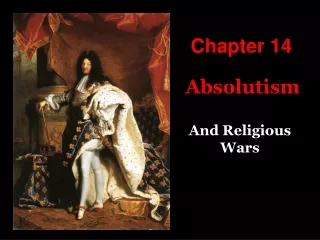
The Sword symbolizes Military Power The Scepter and Crown symbolizes Royalty The Clothes and Room Symbolizes Wealth and Prestige Finally the Athletic Stance shows youth and prowess The Flore De Lis Symbolizes the State
The Middle Ages The Causes of Absolutism in Europe • The End of Feudalism and the Centralization of Power in the Kings • The Growth of Nationalism The Crisis 1.) Fear and Civil Unrest in the Major Countries of Europe due to so much Change 2.) Growth of Armies to Deal with this Rise in Conflict and Civil Unrest 3.) Higher Taxes and more demand placed on the Peasants and Middle Class Absolute Monarchy Renaissance and Reformation • The Growth of Nationalism • The Weakening of the Church’s Power • Religious Conflict Monarchs gain Absolute Power in Europe as a way to deal with Growing Crisis Exploration and Colonization • Growth of Middle Class Merchants in Cities • Territorial Conflict