Calculation of Gravitational Force and Coefficient of Friction
This document outlines examples of gravitational force calculations and the coefficient of friction using mass and distance. It includes two scenarios for gravitational force acting between students and particles, detailing the necessary parameters and equations to derive net forces using Newton's law of universal gravitation. Additionally, it explores the calculation of the coefficient of friction for objects sliding across surfaces at constant velocities, providing step-by-step methodology for determining acceleration due to gravity and frictional forces.

Calculation of Gravitational Force and Coefficient of Friction
E N D
Presentation Transcript
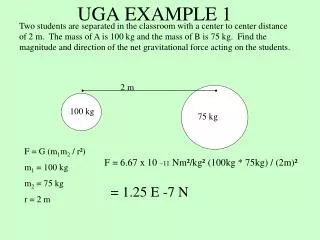
UGA EXAMPLE 1 Two students are separated in the classroom with a center to center distance of 2 m. The mass of A is 100 kg and the mass of B is 75 kg. Find the magnitude and direction of the net gravitational force acting on the students. 2 m 100 kg 75 kg F = G (m1m2 / r²) m1 = 100 kg m2 = 75 kg r = 2 m F = 6.67 x 10 –11Nm²/kg² (100kg * 75kg) / (2m)² = 1.25 E -7 N
UGA EXAMPLE 2 Two particles are separated in space with a center to center distance of 0.478 m. The mass of A is 365 kg and the mass of B is 765 kg. Find the magnitude and direction of the net gravitational force acting on the particles. 0.478 m 365 kg 765 kg F = G (m1m2 / r²) m1 = 365 kg m2 = 765 kg r = 0.478 m F = 6.67 x 10 –11 Nm²/s² (365kg * 765kg) / (.478m)² = 8.15 E -5 N
EXAMPLE In progress Calculate the acceleration of gravity on the earth if you know its mass to be 5.98 E 24 kg. 0.478 m 365 kg 765 kg a= G (m2/ r²) m1 = 365 kg m2 = 765 kg r = 0.478 m F = 6.67 x 10 –11 Nm²/s² (365kg * 765kg) / (.478m)² = 8.15 E -5 N
Calculate μ when a 6 kg box requires 3 N of force to slide at constant velocity on a horizontal surface. v= constant a= 0 m/s² Fnet = 0 FF = 3 N Fg=Fw=FN = 60 N μ= FF/ FN FN = 60 N μ= 3 N / 60 N = .05 FF= 3 N Fpull= 3 N 6 kg Fg = 6 kg (10 m/s²) = 60 N
Calculate μ when a 4 kg box requires 30 N of force to slide at constant velocity on a horizontal surface. v= constant a= 0 m/s² Fnet = 0 μ= Ff / FN FF = 30 N Fg=Fw=FN = 40 N FN = 40 N μ= 30 N / 40 N = .75 FF= 30 N Fpull= 30 N 4 kg Fg = 4 kg * 10 m/s² = 40 N
Calculate μ when it takes 186 N to slide a 59.9 kg box across a horizontal slushy ice rink at an acceleration of 0 m/s2? a= 0 m/s² Fnet is 0 μ= Ff / FN FN = 599 N FF = 186 N FF= 186 N Fpull= 186 N 59.9 kg Fg=Fw=FN = 599 N Fg = 59.9 kg * 10 m/s² = 599 N μ= 186 N / 599 N = 0.31