Understanding Derivatives: Functions, Graphs, and Differentiability Explained
This article explores the concept of derivatives as functions, providing clear examples of how to find the derivative of a function and determine its domain. It discusses the properties of differentiable functions, including the requirements for differentiability in open intervals and the relationship between continuity and differentiability. Graphical illustrations aid in understanding, and comparisons between functions and their derivatives are presented using calculators. Key distinctions are made regarding functions that may be continuous yet not differentiable, highlighting common pitfalls encountered in calculus.

Understanding Derivatives: Functions, Graphs, and Differentiability Explained
E N D
Presentation Transcript
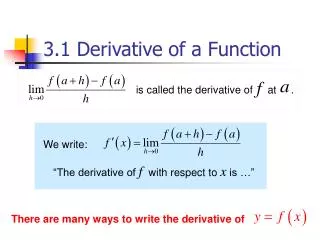
Example Forfind the derivative of f and state the domain of f’
Example Given the graph of the function, f , sketch the graph of f’
Example If find a formula for f’(x). Graph both functions on the calculator and compare.
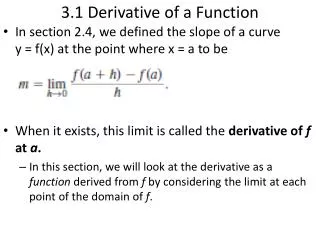
Differentiable A function is said to be differentiable at a is f’(a) exists. It is differentiable on an open interval (a,b) if it is differentiable at every number on that interval. If a function is differentiable at a, then it is continuous at a Some functions can be continuous, but still not differentiabl
Example Where is differentiable.
Functions that are NOT differentiable Graphs with kinks or corners do not have tangents at the kinks, so they are not differentiable Functions that have jump discontinuities at a point are not differentiable at that point If a tangent line to a function is vertical at a point, the function is not differentiable at that point