Download
1 / 10
100 likes | 209 Vues
Explore the orbits of Milky Way satellites, globular clusters, stars, and tidal streams. Investigate MW satellite system alignments and quantities consistent with predictions. Discover key observables in dwarf galaxy and globular cluster evolution.

E N D
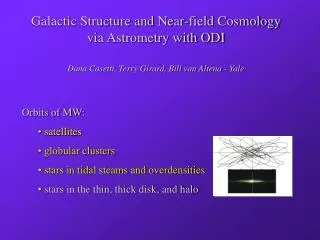
Galactic Structure and Near-field Cosmology via Astrometry with ODI Dana Casetti, Terry Girard, Bill van Altena - Yale • Orbits of MW: • • satellites • • globular clusters • • stars in tidal steams and overdensities • • stars in the thin, thick disk, and halo
Satellites -Spatial alignment of the traditional 11 dwarf sph. (Lynden-Bell 1976, 1982, Kunkel & Deemers 1976). -Newly found ultra-faint dwarfs follow this alignment (Metz et al. 2009). -Proper motions of 6 dwarf satellites indicate that their orbital angular momenta are aligned -> rotationally supported disk of satellites (Metz et al. 2008). Metz et al. 2009, 2008 Only 7 satellites have p.m. measured (with 0.04 to 0.25 mas/yr errors). HST and ground-based observations do not agree.
Satellites: current proper motions. How good are they? A case study: Fornax - 140 kpc Piatek et al. 2002 (before CTI correction) Dinescu et al. 2004 Piatek et al. 2006
Satellites - summary • The formation of the MW satellite system: is it consistent with CDM predictions? • Need to properly quantify: • the input of tides into mass estimates of dwarfs (missing satellite problem, nature of dwarfs) • spatial and associated kinematical alignments • Key observables: orbital eccentricities and angular momenta Add-on project - 9 dwarf galaxies; some need both epochs with ODI, and some only 2nd epoch with ODI (existing 1st-epoch material, OPTIC and plates).
Globular Clusters Clusters with very extended blue horizontal branches (EHBs) appear to have multiple main sequences, subgiant branches. NGC 2808: EHB-strong Piotto 2007 Castellani et al. 2006
Globular Clusters From 94 clusters with HB classification (Lee et al. 2007): - There are 26 EHB clusters that make up 53% of the total mass of the GC system. - 65% of the EHBs (58%, excluding 2 poor measurements*) have orbits measured. EHB clusters :17 Everything else: 29 with [Fe/H] < -1 7 with [Fe/H] > -1.0 (star symbols)
Tidal Streams/Overdensities (Sgr.) Sagittarius stream: measuring the LSR velocity LSR vel: Main survey: the 2h region Vel. difference => 0.3 mas/yr => need p.m. of ~0.1 mas/yr => @0.5mas/yr/star need ~30 stream stars To V ~ 20 in a 40x40 arcmin area: 10 RV members => for 9 sq. deg ~ 200 members. 180 km/s 220 km/s 260 km/s Sgr core Extensions Main: 2h region Law et al. 2005, Majewski et al. 2006
Tidal Streams/Overdensities The Monoceros/Anticenter stream: main survey region at R.A. ~ 8 or 9h, Dec = 0. 9h 8h Grillmair et al. 2006, 2008
Tidal Streams/Overdensities • Their origin and disruption history, the MW potential, the LSR velocity, the lumpiness of the MW halo • Need to properly quantify: • membership to a stream ( sky overlap between different streams) • 3D kinematics along large angular extensions of a stream • Key observables: proper motions, radial velocities, orbits Add-on project - Sgr stream, Monoceros stream, Virgo overdensity, possibly a few others. Fields separated by 5 deg in the equatorial stripe (58 fields ), the dec=+15deg stripe (8), and the dec=-15 deg stripe (13). Of 79 fields, 27 have 1st epoch plate material.
Observing Plan 5+3 dithered exposures of 5 min each in i and g per field => 45 min/field for 114 fields => in all ~ 11 nights to obtain single-epoch data.