Understanding Early Atomic Models: From Democritus to Dalton
190 likes | 308 Vues
This section explores the fundamental concept of atoms, the smallest particles of elements that retain their unique identity in chemical reactions. It discusses early philosophical ideas about atomic structure, notably those proposed by Democritus, who described atoms as indivisible and indestructible. The text also covers John Dalton's contributions, transforming these ideas into a scientific theory backed by experimental methods. Additionally, it highlights the instruments, such as scanning tunneling microscopes, that allow scientists to observe individual atoms despite their minuscule size.


Understanding Early Atomic Models: From Democritus to Dalton
E N D
Presentation Transcript
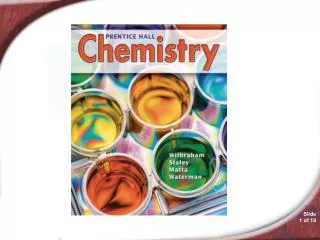
Defining the Atom 4.1 • The lab technician shown here is using a magnifying lens to examine a bacterial culture in a petri dish. When scientists cannot see the details of what they study, they try to obtain experimental data that help fill in the picture.
4.1 Early Models of the Atom • Early Models of the Atom • An atom is the smallest particle of an element that retains its identity in a chemical reaction. • Philosophers and scientists have proposed many ideas on the structure of atoms.
4.1 Early Models of the Atom • Democritus’s Atomic Philosophy • How did Democritus describe atoms? Democritus
4.1 Early Models of the Atom • Democritus believed that atoms were indivisible and indestructible. • Democritus’s ideas were limited because they didn’t explain chemical behavior and they lacked experimental support.
4.1 Early Models of the Atom • Dalton’s Atomic Theory • How did John Dalton further Democritus’s ideas on atoms?
4.1 Early Models of the Atom • By using experimental methods, Dalton transformed Democritus’s ideas on atoms into a scientific theory. • The result was Dalton’s atomic theory.
4.1 Early Models of the Atom All elements are composed of tiny indivisible particles called atoms.
4.1 Early Models of the Atom • Atoms of the same element are identical. The atoms of any one element are different from those of any other element.
4.1 Early Models of the Atom • Atoms of different elements can physically mix together or can chemically combine in simple whole-number ratios to form compounds.
4.1 Early Models of the Atom • Chemical reactions occur when atoms are separated, joined, or rearranged. Atoms of one element are never changed into atoms of another element in a chemical reaction.
4.1 Sizing up the Atom • Sizing up the Atom • What instruments are used to observe individual atoms?
4.1 Sizing up the Atom • Despite their small size, individual atoms are observable with instruments such as scanning tunneling microscopes.
4.1 Sizing up the Atom • Iron Atoms Seen Through a Scanning Tunneling Microscope
4.1 Section Quiz • 4.1.
4.1 Section Quiz • 1. The ancient Greek philosopher credited with suggesting all matter is made of indivisible atoms is • Plato. • Aristotle. • Democritus. • Socrates.
4.1 Section Quiz • 2. Dalton's atomic theory improved earlier atomic theory by • teaching that all matter is composed of tiny particles called atoms. • theorizing that all atoms of the same element are identical. • using experimental methods to establish a scientific theory. • not relating atoms to chemical change.
4.1 Section Quiz • 3. Individual atoms are observable with • the naked eye. • a magnifying glass. • a light microscope. • a scanning tunneling microscope.