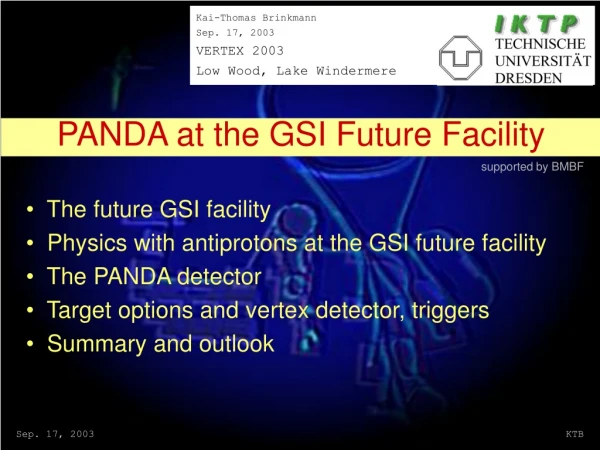
Physics with p at the Future GSI Facility
220 likes | 354 Vues
The GSI High Energy Storage Ring (HESR) facilitates advanced high-energy physics studies, focusing on charm quarks and hadronic physics. Its innovative detector setup supports high luminosity and precision measurements for meson spectroscopy, including charmonium states and potential exotic states such as glueballs and hybrids. The facility enables investigations into medium modifications of D mesons and J/Ψ in nuclear matter, alongside studies of CP violation in hyperon decays. With precision cooling and sophisticated tracking, HESR aims to unveil the intricacies of quantum chromodynamics and hadron formation.


Physics with p at the Future GSI Facility
E N D
Presentation Transcript
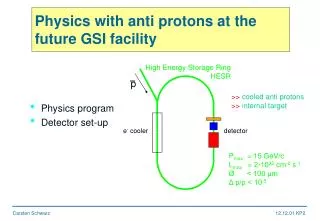
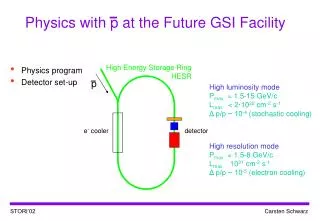
Physics with p at the Future GSI Facility High Energy Storage Ring HESR • Physics program • Detector set-up p High luminosity mode Pmax = 1.5-15 GeV/c Lmax < 2·1032 cm-2 s-1 Δ p/p ~ 10-4 (stochastic cooling) e- cooler detector High resolution mode Pmax = 1.5-8 GeV/c Lmax 1031 cm-2 s-1 Δ p/p ~ 10-5 (electron cooling)
Charmonium spectroscopy Medium modifications of D mesons and J/Ψ in nuclei Hypernuclei Glueballs Hybrids CP violation Physics program
Charmonium gives information about QCD confinement potential. • Many states are still missing. • pp: direct formation of all states. • HESR allows investigation of states above DD threshold. • Cooled beams with Δp/p=10-4…10-5 allow high precision scan of resonances. Charmonium spectroscopy Crystal Ball e+e- 40 keV
Charmonium spectroscopy Crystal Ball e+e-
Signal: exotic quantum numbers: partial wave analysis normal quantum numbers: model comparison (LGT) Glueballs Hybrids mixing with normal mesons charm sector: few resonances with small widths Meson Hybrid Glueball ggg qq qqg Normal meson: 2 fermions P = (-1)L+1 C = (-1)L+S Excited glue: bosonic degree of freedom → exotic quantum numbers eg. JPC=1-+, 0--, 0+-, 2+-… → normal quantum numbers
Glueballs Hybrids
Mass modifications of mesons pionic atoms π- 25 MeV π π+ KAOS/FOPI K+ K 100 MeV K- HESR D D- 50 MeV ? D+ vacuum nuclear medium ρ = ρ0 Medium modifications of D mesons and J/Ψ in nuclei Continuation of present GSI physics FOPI, KAOS, HADES, …HESR Signal: medium modification of production threshold, resonance width e.g. Ψ’, χ2 Absorption cross section of J/Ψ in nuclei (ρ=ρ0).
_ X 3 GeV/c p X- Hypernuclei K+K Trigger • X-(dss)p(uud)L(uds)L(uds) • study of L L interaction secondary target
p + p → Λ +Λ ↓ ↓ pπ- pπ+ CP violation in Hyperon decay • Signal for CP violation: • Theoretical prediction: • Experiment: 1010 reconstructed ΛΛ • L=2·1032 cm-2 s-1 → >1 year running • Measure decay asymmetry of angular distribution of p relative to Λ-Hyperon momentum. • Ip(θp) ~ 1+α cos(θp) for Λ • Ip(θp) ~ 1+α cos(θp) for Λ • CP conservation: α = - α
Angular acceptance Formation of Ψ’and decay in myons electrons similar → calorimeter for large angles. Ψ’→μ+μ- Ψ’→J/Ψ + X ↓ μ+μ-
HESR Detector target spectrometer forward spectrometer Internal target top view Heavy charmed mesons decay in light products with large pt. Solenoid is important.
Particle identification p+p → ΦΦ→ 4K s½ =3.6 GeV • Forward angles need π/K separation up to 3 GeV/c: Cherenkov n=1.02 • Backward: higher value of n.
2 mio. forward pixels 100 x 150 μm 7.2 mio. barrel pixels 50 x 300 μm beam pipe pellet pipe Tracking, Micro Vertex Detector Readout: ASICs (ATLAS/CMS) 0.37% X0 or pixel one side – readout other side (TESLA)
σZ0=82 μm σD0=51 μm y z D0 Z0 x MVD, single track resolution p p 8.5 GeV 2π+ 2π- Vertex resolution is sufficient for D-physics c(D) = 314 μm, c(D0) = 124 μm
pp(s = 4.4 GeV/c2) J/+f. Target spectrometer, momentum resolution MVD straw tubes MDC σM= 1.2% ???
Particle identification • PID from • 00<Θ<50 hadronic calorimeter • 50<Θ<220 Aerogel Cherenkov Counters • 220<Θ<1400 DIRC (BABAR@SLAC) DIRC thickness: 0.19 X0
pp(s = 4.4 GeV/c2) J/+f. Particle identification
Calorimeter 22o 140o 5o PbWO4 Length = 17 X0 APD readout (in field) σ(E) = 1.54% / E½ + 0.3% (PM) pp J/Ψ+η γγ
10 e±/π±sep. 8 e+/- 6 Edep (GeV/c) 4 2 π+ 0 2 4 6 8 p (GeV/c) π+ probability 10-3 electron/pion separation 10-3 0 2 4 6 8 p (GeV/c)
Pellet target 1 mm • Frozen hydrogen pellets 20-40μm • Δx=±1 mm (±0.04o) • 60 m/s • 70000 pellets/sec. • 1014-1016 atoms/cm2 (avg.)