Estimating the Integral of Tan x Using Midpoint, Trapezoid, and Simpson's Rules
30 likes | 185 Vues
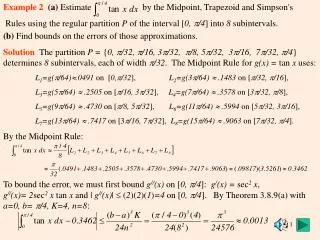
This solution estimates the integral of the function g(x) = tan(x) over the interval [0, π/4] using Midpoint, Trapezoid, and Simpson's Rules with a partition into 8 subintervals of equal width (π/32). Each method's corresponding approximations are calculated, and bounds on the errors of these approximations are determined using derivatives of g(x). Key values such as error bounds and computation outcomes for each method are detailed for enhanced understanding.


Estimating the Integral of Tan x Using Midpoint, Trapezoid, and Simpson's Rules
E N D
Presentation Transcript
Example 2 (a)Estimate by the Midpoint, Trapezoid and Simpson's Rules using the regular partition P of the interval [0, /4] into 8 subintervals. (b) Find bounds on the errors of those approximations. Solution The partition P = {0, /32, /16, 3/32, /8, 5/32, 3/16, 7/32, /4} determines 8 subintervals, each of width /32. The Midpoint Rule for g(x) = tan x uses: L1=g(/64).0491 on [0,/32], L2=g(3/64) .1483 on [/32, /16], L3=g(5/64) .2505 on [/16, 3/32], L4=g(7/64) .3578 on [3/32, /8], L5=g(9/64) .4730 on [/8, 5/32], L6=g(11/64) .5994 on [5/32, 3/16], L7=g(13/64) .7417 on [3/16, 7/32], L8=g(15/64) .9063 on [7/32, /4]. By the Midpoint Rule: To bound the error, we must first bound g//(x) on [0, /4]: g/(x) = sec2x, g//(x)= 2sec2x tan x and | g//(x)| (2)(2)(1)=4 on [0, /4]. By Theorem 3.8.9(a) with a=0, b= /4, K=4, n=8:
P = {0, /32, /16, 3/32, /8, 5/32, 3/16, 7/32, /4} The Trapezoid Rule for g(x) = tan x uses: L1=½[g(0)+g(/32)] .0492 on [0,/32], L2=½[g(/32)+g(/16)] .1487 on [/32, /16], L3=½[g(/16)+g(3/32)] .2511on [/16, 3/32], L4=½[g(3/32)+g(/8)] .3588 on [3/32, /8], L5=½[g(/8)+g(5/32)] .4744 on [/8, 5/32], L6=½[g(5/32)+g(3/16)] .6011 on [5/32, 3/16], L7=½[g(3/16)+g(7/32)] .7444 on [3/16, 7/32], L8=½[g(7/32)+g(/4)] .9103 on [7/32, /4]. By the Trapezoid Rule: By Theorem 3.8.9(b) with a=0, b= /4 , K=4, n=8:
P = {0, /32, /16, 3/32, /8, 5/32, 3/16, 7/32, /4} g//(x)= 2sec2x tan x By Simpson’s Rule with x = /32 and g(x) = tan x: To bound the error on this estimate, we must first bound g(4)(x) on [0, /4]. g(3)(x) = (4sec x)(sec x tan x)(tan x) + (2sec2 x )(sec2 x) = 4sec2 x tan2 x + 2sec4 x, g(4)(x) = (8sec x)(sec x tan x)(tan2 x) + (4sec2 x)(2tan x)(sec2 x) + (8sec3 x)(sec x tan x) = 8sec2 x tan3 x + 16sec4 x tan x. Hence |g (4)(x)| 8(2)(1)+16(4)(1) = 80 on [0, /4]. By Theorem 3.8.16 with a=0, b= /4, M=80, n=8: