
pCVD diamond
E N D
Presentation Transcript
pCVD diamond J. Buytaert
some interesting facts • The sales of synthetic diamond material overtook that of natural industrial diamond products as long ago as 1978. • In 2000 world consumption of industrial diamond passed the one billion carat milestone. • cvd diamond often quality exceeds natural diamond properties, less or controlled impurities. • cvd apparatus are now quite common and ‘affordable’. • quality grades : “thermal” (‘cheap’) and “optical”(‘more expensive’). But, unfortunately high thermal (K>1800 W/Km) quality == optical quality ! • price high thermal quality: • online quote “TM180” from Elementsix,Ltd : 1cm^2 , 250um = 85 euro. • ‘price indication’ (Diamond materials) : 80 mm disk, 250um : ~3000 euro. (~60 e/cm^2). • grow rate 1-2 um/hour. (150um -> 1week !)
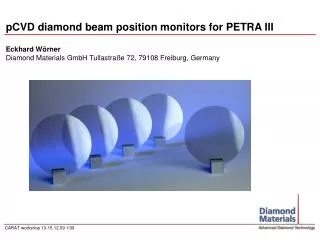
‘Diamond materials’ company • 1 day visit. • small spin-off from Fraunhofer institut, Freiburg, Germany. • started in 2004, 8 engineer/physicist. • small production capacity at the moment.(13 ovens), aimed at optical quality. • also produce patented cvd equipment; “P30” oven • can gear-up production rapidly. • research oriented, very interested in new applications. • have contacts with Dulinsky (strasburg, mimosa) and H. Kagan
‘Diamond materials’ company. • have all processing steps in-house: • grinding, polishing • laser cutting • metallization • quality control • mounting techniques • 20 years of research experience on cvd diamond. • ‘ideal’ developing partner ?
‘Diamond materials’ company. • learned: • that Velopix module concept is very ‘viable’ (geometry, cutting, thermal aspects). • currently limited to 80mm disks. They are developing 150mm oven. • 80 mm/ 250 um disk feels like a ‘rigid plastic’: quite resilient/flexible. • 80 mm disk has typically 0.5mm out-of plane ‘bowing’ in center. • depends on thickness. 150 um ? • can be flattened by constrain. No risk for breaking. • Disappears when cut. • probably inherent to poly-crystalline cvd technique : unequal grain structure on nucleation and grow side. All manufactures. • diamond can be brazed to metals (Cu) and diamond ! Interesting for mechanical construction and cooling interfaces !
Degradation of thermal conductivity with irradation ? • 33rd EPS Conference on Plasma Phys. Rome, 19 - 23 June 2006 ECA Vol.30I, P-1.119 (2006) . Radiation-hard ceramic materials for Diagnostic and Heating and Current Drive systems for ITER. • we agreed with Diamond materials on an irradiation of a sample. They can measure thermal ‘in-plane’ conductivity with 2 mm resolution.
Elementsix,Ltd (UK) • World leader in industrial CVD diamond. • Also strong research branch. • provide detector grade diamond to RD42 • “DIAFILM TM180”: should ask for large dimensions. • “ScD Thermal”: silicon-carbide-diamond ?
Further: • At CERN other groups are interested in pCVD diamond for low-mass mechanical, cooling substrate: • NA62 Gigatracker ( in contact with A. Kluge, P. Riedler, G Nuessle). • cooling section PH/DT (R. Dumps, P. Petagna): • plan to setup evaluation stand. • University of bristol : http://www.chm.bris.ac.uk/pt/diamond/
Immediate plans: • build ‘thermal study module’: 1 Medipix/Timepix on CVD substrate, with cooling interface in vacuum, with PH/DT. Readout compatible with USB module. • contact Elementsix. • irradiation test for thermal conductivity degradation ( April 2010)