
Transcriptomic and Proteomic Insights into Invasiveness of Phragmites australis
This study presents a comprehensive analysis of the common reed, Phragmites australis, utilizing next-generation sequencing to explore its transcriptomic and proteomic profiles. The research reveals key genes associated with the species' invasiveness and specific adaptations related to rhizome development. The findings contribute to our understanding of the mechanisms driving the spread of P. australis in various ecosystems, supported by detailed data supplements outlining child terms in transport, signal transduction, and metabolic processes related to gene expression and function.

Transcriptomic and Proteomic Insights into Invasiveness of Phragmites australis
E N D
Presentation Transcript
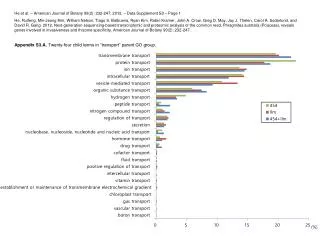
He et al. – American Journal of Botany 99(2): 232-247. 2012. – Data Supplement S3 – Page 1 He, Ruifeng, Min-Jeong Kim, William Nelson, Tiago S. Balbuena, Ryan Kim, Robin Kramer, John A. Crow, Greg D. May, Jay J. Thelen, Carol A. Soderlund, and David R. Gang. 2012. Next-generation sequencing-based transcriptomic and proteomic analysis of the common reed, Phragmites australis (Poaceae), reveals genes involved in invasiveness and rhizome specificity. American Journal of Botany 99(2): 232-247. Appendix S3.A.Twenty-four child terms in “transport” parent GO group. (%)
He et al. – American Journal of Botany 99(2): 232-247. 2012. – Data Supplement S3 – Page 2 Appendix S3.B. Nine child terms in “signal transduction” parent GO group. (%)
He et al. – American Journal of Botany 99(2): 232-247. 2012. – Data Supplement S3 – Page 3 Appendix S3.C.Seventeen child terms in “metabolic process” parent GO group. (%) Appendix S3-C. 17 child terms in “metabolic process” parent GO group