Understanding Thermal Energy and Temperature: Key Concepts in Kinetic Theory
150 likes | 267 Vues
This overview explains the fundamental principles of thermal energy and temperature. Matter is composed of particles in constant random motion; higher particle velocity correlates with increased warmth. The average kinetic energy of an object is measured as temperature, linking thermal energy to both mass and temperature. Heat is the energy transferred from a hotter to a cooler object. Specific heat is defined as the energy needed to raise 1 kg of a substance by 1°C, crucial for applications like cooling systems. The formula Q = mCΔT elucidates the change in thermal energy.


Understanding Thermal Energy and Temperature: Key Concepts in Kinetic Theory
E N D
Presentation Transcript
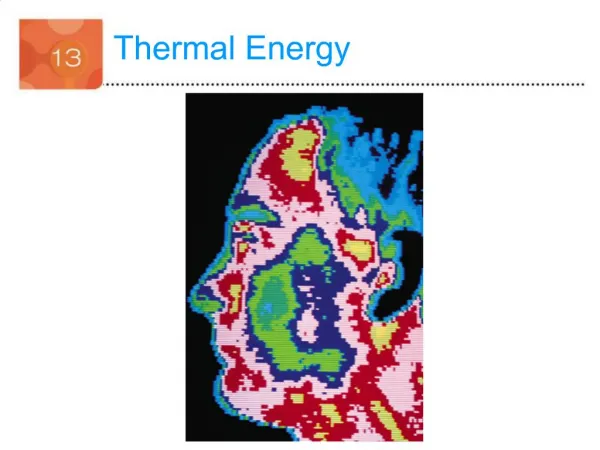
Thermal Energy • Matter is made of particles that are in constant random motion • The faster the particles move, the warmer an object gets
Kinetic Theory • This is the basis of Kinetic Theory
Temperature • Temperature is the measure of average kinetic energy of an object • Temperature and energy are directly related • The more kinetic energy, the higher the temperature • The more potential energy, the lower the temperature
Temperature • The standard unit for temperature is Kelvins (K) • We also use Celcius and Farenheit • Kelvin -273 = ˚C
Thermal Energy • The total of the Kinetic Energy and Potential Energy of all particles in an object. • Thermal energy and temperature are directly related • Thermal energy and mass are directly related
Heat • Thermal energy that flows from something at a higher temperture to something at a lower temperature is called heat • Heat is measured in Joules (J) • An example is when you get up from a chair and it is warm to the touch. • In science, ther is no cold, only absence of heat
Specific Heat • Specific heat is the amount of heat needed to raise 1 kg of a substance 1 ˚C • It is measured in J/kg ˚C
Specific Heat • Water has a very high specific heat. • It is good as a coolant in radiators
Formula for Change in Thermal Energy • The formula for thc change in thermal energy is Q = mCΔT • Q – the change in thermal energy • M – mass of the object • C – specific heat of the substance • ΔT – change in temperature (T final – T initial)