Chapter 17, Section 2
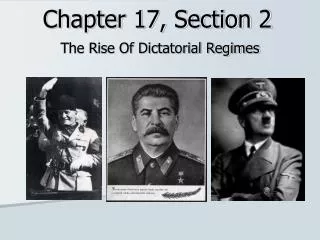
Chapter 17, Section 2. The Rise Of Dictatorial Regimes. The Rise of Dictators. By 1939 France and Great Britain still Democratic Soviet Union, Germany, and many others have become dictatorships. A Totalitarian State

Chapter 17, Section 2
E N D
Presentation Transcript
Chapter 17, Section 2 The Rise Of Dictatorial Regimes
The Rise of Dictators • By 1939 • France and Great Britain still Democratic • Soviet Union, Germany, and many others have become dictatorships. • A Totalitarian State • A government that aims to control the political, economic, social, intellectual, and cultural lives of its people. • Used mass propaganda and new technology • Led by a single leader and a single party • Traded individual freedom for the collective will of the masses.
Fascism in Italy • Benito Mussolini • Created the League of Combat • Fascio di combattimento • Fascism: • Emphasizes a strong central government, lead by a dictatorial ruler. People are controlled by the government and anyone who disagrees is dealt with in force.
Fascism on the rise • Mussolini grows out of the hardships caused by WWI • Creates a group called the Squadristi • Italians feared that there would be a Socialist revolution or a Communist takeover • The Squadristi use violence to fight against socialist ideas • They demand more land for Italy and this gains the support through patriotism and nationalism
Takeover of Government and the Fascist State • “either we are allowed to govern or we will seize power” • King Victor Emmanuel III gives over power • Outlaw all other political parties and establish secret police OVRA • Il Duce • Brainwashing the population • Media - “Mussolini is always right”
Youth Groups • Portrayed families as the center of society • Women were born to be homemakers • Failures of Mussolini • Never gained total control • Compromise with the Catholic church • Lanteran Accords • Established the Vatican City as an independent area for the church • The Church recognized and promoted the catholic state
A New Era for the Soviet Union • Communist under Lenin • After WWI peasants begin to sabotage the Communist system • Lenin’s NEP (New Economic Policy) • Peasants and merchants could sell products openly, but industry, banking, and mining were still controlled by the government • 1922, Russia becomes the U.S.S.R. • This combination of policies from Lenin saved the Soviet Union from economic crisis.
Shift from Lenin to Stalin • Lenin dies in 1922 • Politburo – had been the policy making body of the Communist party, becomes divided. • The two strongest groups were lead by Leon Trotsky and Joseph Stalin • Stalin had a position which allowed him to appoint officials • Appoints thousands of supporters • Trotsky is expelled from the party in 1927 http://www.dpcamps.org/stalin.jpg
Stalin’s 5-Year Plans • 1928 – Ends the NEP and implements his first 5 Year Plan • Maximum production of capital goods and weapons • Huge increases in production were made • Came at the cost of low wages and extremely poor living conditions for workers. Laws even limited where workers could move. • Collectivization: Government owned all of the land and peasants worked on it.
Costs of Stalin’s Program • 10 million peasants die in 1932 and 1933 • Great Purge of the 1930’s • In his desire for power, Stalin arrested 8 million Russians and sent many to labor camps in Siberia • Extreme restrictions on the lifestyles of the people.
Authoritarian States in the West • Authoritarianism: • Adopt some features of totalitarianism (police force), but focus on preserving society rather than reinventing it • Most countries established democracies after WWI • These systems are largely replaced
Reasons Democracy Failed • No tradition of Democracy • Rural and Agrarian Societies • Uneducated peasants • Ethnic and Religious conflicts • Fear of revolution made authoritarian systems logical because they would maintain the old system
Spain • Francisco Franco – Lead a military attack on the Democratic government. • Caused a bloody Civil War • Italy and Germany aid Franco • The Soviet Union aids the government • Franco wins the war by capturing Madrid in 1939 • He then established a dictatorship • Favored traditional groups like landowners, businesspeople, and the Catholic church. • Makes him authoritarian rather than totalitarian
17.3: Hitler and Nazi Germany • Hitler’s Background and Views • Born in Austria • Performed poorly in school and moved to Vienna to pursue art • 3 Beliefs • Racism (especially anti-Semitism) • Extreme nationalism (political parties could effectively use propaganda and fear) • Need for struggle
Joins the German Workers’ Party • Quickly takes control and renamed it the National Socialist German Workers Party • The Beer Hall Putsch • Hitler tried to overtake the government but was caught • Sentenced to jail time and wrote Mein Kampf while in jail
Nazis on the Rise • Hitler released from prison, increased the popularity of the Nazi party • It became the largest party in the Reichstag (German parliament) • Promised a New Germany • Appealed to the masses, had large numbers of followers
Nazism is Successful • President Hindenburg gives control over to Hitler in order to prevent a Communist takeover • Hitler completely controls Germany • March 23, 1933: Enabling Act • Gave the government the power to ignore the Constitution for 4 years • Opposition placed in concentration camps and all other political parties dissolved • Hindenburg dies and Hitler becomes the Führer
Nazi Control • Fought for complete control by the Aryan race • Third Reich • First: Holy Roman Empire • Second: German Empire 1871-1918 • Pursued this through totalitarianism • Total control/power
State of Terror • Schutzstaffeln • (SS) • Originally Hitler’s bodyguards • Then used to maintain order • Led by Heinrich Himmler, lead all police forces in Germany and ensured Nazi Rule • 2 Main Goals • Terror through repression and murder (secret police, criminal police, concentration camps, later execution squads and death camps) • Ideology- further the Aryan race
Economics • Public works projects, grants, and re-armament pull Germany from the Great Depression • Unemployment in 1932: 6 million • In 1934: 2.6 million • In 1937: less than 500,000
Organizations • Nuremberg Party Rallies: every September • Evoked mass enthusiasm and excitement • Nazis controlled education and churches • Professional organizations and leagues formed for civil servants, teachers, women, farmers, doctors, lawyers • Also youth organizations to teach Nazi ideals
Women • Seen as the bearers of the children who would bring triumph to the Aryan race • Pushed to stay out of work • Those who did work went into nursing or social work
Anti-Semitism • Nuremberg laws: no citizenship, no intermarriage, and forced Jews to wear the Star of David • Kristallnacht: “night of shattered glass” • Nazis burned synagogues and businesses • Sent 30,000 Jews to concentration camps • Barred from public services
Led to More Drastic Steps • Jews barred from all public transportation and all public buildings including hospitals and schools • Prohibited from owning, managing, or working in any retail store • Forced to clean up all debris and damage due to Kristallnacht • Encouraged to “emigrate from Germany” under direction of the SS