Download
1 / 45
470 likes | 606 Vues
This educational material focuses on identifying musical notes and their corresponding lines and spaces in staff notation. It guides learners to count and recognize notes from the bottom up, with each line and space labeled with a letter name from A to G. Various exercises like naming notes and singing mnemonic songs, such as the E-G-D-B tune, are included to enhance memory retention. Suitable for beginners, this resource fosters foundational music reading skills.

E N D
Lines and Spaces
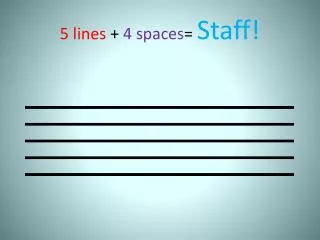
The staff has 5 lines. 5. 4. 3. 2. 1. Count the number of each line from the bottom.
Which line is this? 4. 3. 2. 1.
Which line is this? 2. 1.
Which line is this? 5. 4. 3. 2. 1.
Which line is this? 3. 2. 1.
The staff also has 4 spaces between the lines. 4. 3. 2. 1. Count from the bottom.
Which space is this? 3. 2. 1.
Which space is this? 4. 3. 2. 1.
Which space is this? 2. 1.
Each LINE has a letter name. Each SPACE has a letter name. Lines F Spaces E D C B A G F E
Each line has a letter name. Each space has a letter name. Only use ABCDEFG. Remember, the bottomline is “E.” F E D C B A G F E
When you say both the lines and the spaces, you use the first 7 letters of the alphebet. F E D C B A G F E
You can name the linesby saying: F Fudge D Deserves B Boy G Good E Every
Watch for the correctline or space asyou sing the song. F D D B B G G e e
f E D C B A G f e
F D D B B G G e e
Sing it again! f E D C B A G f e
Point to the correctline or space asyou sing the song. F D D B B G G e e
f E D C B A G f e
F D D B B G G e e
Fantastic! f E D C B A G f e
Name the notes. D. B. G.
Name the notes. F. B. E.
Name the notes. B. G. E.
Name the notes. D. G. E.
Name the notes. D. B. E.
Name the notes. G. G. E.
You can name the spacesby spelling a word thatrhymes with space. E C AF G E Can you find the word? C A F D
Name the notes. C. A. F.
Name the notes. C. F. F.
Name the notes. E. C. F.
Name the notes. A. A. F.
Name the notes. E. C. A.
Name the notes. E. A. F.
You must first look to see ifthe note is a line note,or a space note. A. G. E.
Name the notes. F. A. G.
Name the notes. E. B. G.
Name the notes. C. F. E.