The Downfall of Ancient India: Cultural Values and Technological Impact
This assessment explores the factors contributing to the rise and fall of Ancient India, focusing on its cultural value system and technological developments. Students will analyze the significance of innovations and trade in shaping India’s civilization, particularly during the Maurya, Sunga, Kushan, and Gupta Empires. The project includes a graphic organizer and a written response that assesses how cultural values impacted India's success, the effects of invasions, and the aftermath of its decline, notably the advent of Muslim invaders and the establishment of the Mojul Empire.

The Downfall of Ancient India: Cultural Values and Technological Impact
E N D
Presentation Transcript
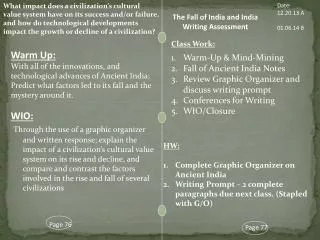
Date: 12.20.13 A 01.06.14 B • What impact does a civilization’s cultural value system have on its success and/or failure, and how do technological developments impact the growth or decline of a civilization? The Fall of India and India Writing Assessment • Warm Up: • With all of the innovations, and technological advances of Ancient India; Predict what factors led to its fall and the mystery around it. • WIO: • Through the use of a graphic organizer and written response; explain the impact of a civilization’s cultural value system on its rise and decline, and compare and contrast the factors involved in the rise and fall of several civilizations Class Work: Warm-Up & Mind-Mining Fall of Ancient India Notes Review Graphic Organizer and discuss writing prompt Conferences for Writing WIO/Closure • HW: • Complete Graphic Organizer on Ancient India • Writing Prompt – 2 complete paragraphs due next class. (Stapled with G/O) Page 76 Page 77
The Greek and Persian Invasion • What they wanted: Gold, Spices (Black Pepper), Cotton, Carburized Steel, Silk (access to China) • By the end of the 6th century BCE, The Persians (Led by Darius I) conquered most of Northern India • In 326 BCE Alexander the Great of Macedonia invaded India. • This helped open India to European Trade, and Helped to unite the tribes against invaders…
Empires 0f Power Maurya Empire • drove out the Persians and Greeks • built Inns, orphanages, hospitals for people • changed India to Buddhism • lots of art and architecture contributions’ • ended due to weak government Sunga Empire • started by general who assassinated the last Mauryan leader • allowed provinces to govern themselves • weak government- Frequent Invasions – lost control due to immigration population increase from Mongolia.
Empires 0f Power Kushan Empire • Controlled Northern India • Embraced Buddhism, but kept Hinduism- allowed for open tolerance and trade. • Lost to Persian invaders - 2nd Century BCE.
The Final Empire Gupta Empire • Began 321 CE- due to a marriage from a princess from the Mauryan dynasty and Chandragupta (Guptan Empire) • Organized most of Northern and Southern India (largest size of Empire) • Known for peace and prosperity • Arts, Architecture, and poetry flourished during the Empire • “The Earth is round” (Is theorized by – Aryabhata)
New Invader “The White Huns” • Massacred all that opposed them • Left soon after burning many cities/towns/ and killing off most of NW population. • India's climate was too hot for them. • This left India open to individual territories, and leaders.
Factors that led to the Fall of India • In the 6th Century the Gupta Empire has become weak • The civilization has become more like city-states, and has less governmental control. • Invasion • Highly desired Trade goods, and trading routes • Art and Architecture • Resources like Cotton, Steel, Spices, Ink • Constant Flooding- caused water sources to move, and left many cities abandoned.
The Aftermath – What happened to India afterwards…. • Muslim Invaders began taking control of much territory by 711 CE • Muslim and Islam create more new religions • Muslims begin the Mojul Empire. • Mojul Empire (Islamic Empire) that tried to get along with Hindu population- Led over India until the 19th Century.